

Fewer Restraints, Same Delirium, No Added Harm: R2D2-ICU and the Art of Reading a Neutral Trial

A landmark 2026 trial tried to prove that using fewer physical restraints would reduce delirium, and it failed. The failure is instructive. Here is why the observational case against restraints did not survive the randomized test, what a neutral de-implementation trial actually tells you, and why no benefit and no harm together still change practice.
Physical restraint is one of the most common things we do to ventilated patients, and one of the least examined. A recent systematic review estimated that roughly 4 in 10 ICU patients are physically restrained, with enormous variation between units that tracks local culture and staffing more than any evidence. The justification has always been intuitive rather than proven: restraints prevent patients from pulling out their breathing tube or their lines. And running against that intuition is a body of observational research linking restraints to exactly the harms we most fear, including agitation, delirium, long-term cognitive impairment, and post-traumatic stress.
So the question is genuinely open. Do restraints protect patients from self-harm, or do they quietly cause the delirium and trauma the observational data describe? The R2D2-ICU trial set out to answer it by testing whether a strategy of using fewer restraints would reduce delirium. In 405 ventilated adults across 10 French ICUs, one group had wrist straps avoided unless severe agitation demanded them, and the other had wrist straps applied systematically and reassessed daily.
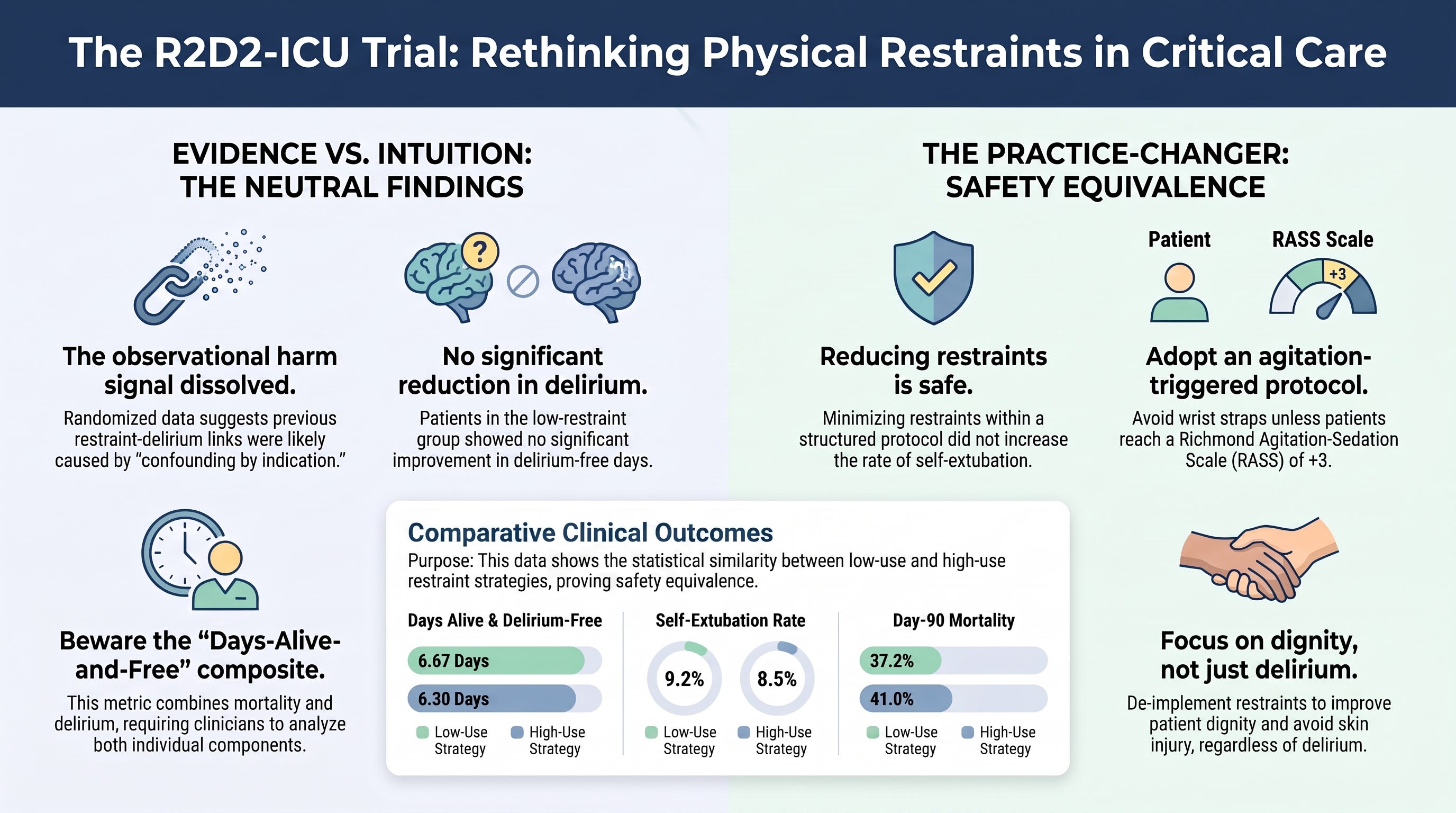
The trial failed to show what it set out to show. Reducing restraints did not increase the days patients spent alive and free of coma or delirium. The difference was 6.67 days against 6.30 days, with a confidence interval that comfortably included no effect and a P value of 0.51. On the surface, a negative trial.
But a negative primary outcome is the beginning of the reading, not the end. Because the same trial found something that does change practice. Using fewer restraints did not increase self-extubation, which occurred in 9.2 percent of the low-use group and 8.5 percent of the high-use group. The great fear that justifies restraint, that patients will pull out their tubes if you let them, did not materialize when restraints were minimized. This Thursday is about how to read that combination, no benefit and no harm, and about why the observational case against restraints did not survive the randomized test.
ICCN Update
The new ICCN website is live at iccn.io. Every article published in the past two weeks is now archived in one place, and our new Research section pulls recent published data from 26 major critical care and medical journals into a single curated feed for subscribers. Bookmark iccn.io.
Why This Matters
Most of critical care research asks whether adding something helps. A smaller and harder category asks whether removing something is safe. These de-implementation questions are among the most important we face, because so much of what we do in the ICU accumulated by habit and inference rather than evidence, and the only way to stop doing it responsibly is to prove that stopping does not harm patients. Physical restraint is a textbook example: widespread, variable, justified by intuition, and shadowed by an observational literature suggesting it does harm.
The difficulty is that de-implementation trials are easy to misread. A neutral result can be taken to mean the intervention does not matter, when it may mean something more specific. And the observational evidence that motivates these trials is especially treacherous here, because it is shaped by a powerful confounder. The patients who get restrained are the agitated, the delirious, and the sickest, which means any observational comparison loads the restrained group with patients already destined for worse delirium and cognitive outcomes. An observational study that finds restraints associated with delirium may be measuring who gets restrained rather than what restraint does. This is the same confounding by indication that has misled critical care across many questions, and it is exactly what a randomized trial is built to break.
R2D2-ICU matters because it breaks that link and reports the result cleanly. It tells us that reducing restraints does not reduce delirium, which suggests the observational restraint-delirium association was substantially confounded, and it tells us that reducing restraints does not increase self-extubation, which is the finding that actually licenses a change in practice. Reading both halves correctly, and neither more nor less than each supports, is the whole discipline.
The patients who get restrained are the agitated, the delirious, and the sickest. An observational study that finds restraints associated with delirium may be measuring who gets restrained, not what restraint does. Only a randomized trial can tell those apart, and this one did.
The Study / Evidence in Context
R2D2-ICU was a French multicenter, parallel-group, open-label randomized trial conducted in 10 ICUs between January 2021 and January 2024. It enrolled 405 adults who had started invasive mechanical ventilation within the previous 6 hours and were expected to require at least 48 hours of ventilation. Patients were randomized to a restrictive, low-use restraint strategy, in which wrist straps were avoided unless the patient had severe agitation defined as a Richmond Agitation-Sedation Scale score of at least 3, or a liberal, high-use strategy, in which wrist straps were applied systematically and reassessed daily. In both groups, restraints could be discontinued once patients were awake or extubated without delirium, assessed with the Confusion Assessment Method for the ICU, and could be restarted for recurrent severe agitation.
The primary outcome was the number of days alive without coma or delirium during the first 14 days after randomization. This is a days-alive-and-free-of composite, and it is worth pausing on, because these outcomes carry an interpretation subtlety. A patient who dies contributes zero days, the same as a patient who is alive but continuously delirious, which means the composite blends the competing outcomes of death and delirium into a single number. It is an efficient and patient-centered outcome, and it requires the reader to remember that a difference in the composite could reflect either mortality or delirium, and that a null result means neither moved enough to register.
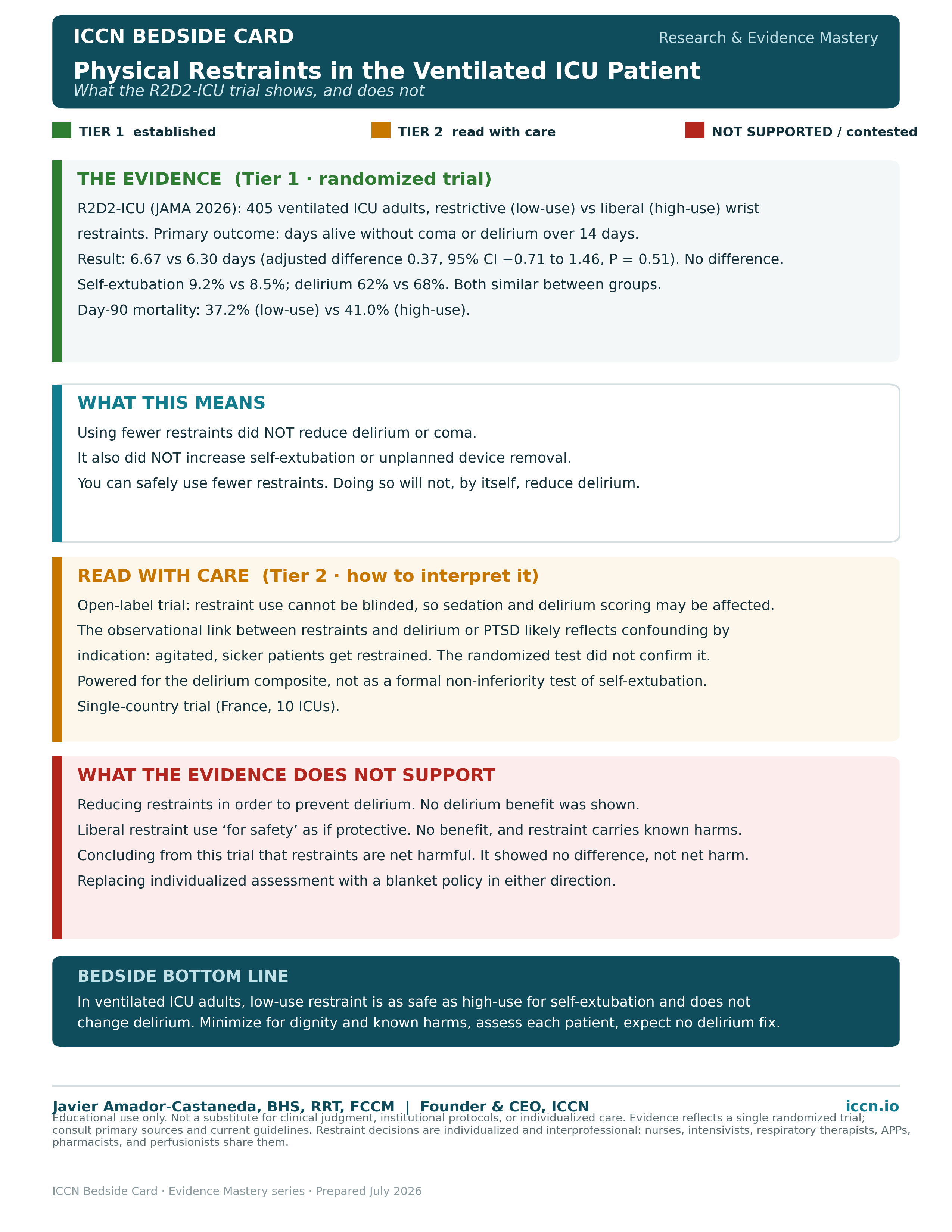
The result was neutral. Among 396 patients with primary outcome data, the mean days alive without coma or delirium were 6.67 in the low-use group and 6.30 in the high-use group, an adjusted mean difference of 0.37 days with a 95 percent confidence interval of negative 0.71 to 1.46 and a P value of 0.51. The secondary outcomes told a consistent story. Delirium occurred in 62.2 percent of the low-use group and 67.5 percent of the high-use group, a difference that did not reach significance. Duration of delirium, days alive without coma, and agitation levels were similar. Self-extubation occurred in 9.2 percent of the low-use group and 8.5 percent of the high-use group. Day-90 mortality was 37.2 percent in the low-use group and 41.0 percent in the high-use group.
The trial sits against a specific evidentiary backdrop. The observational literature, summarized in the accompanying editorial and elsewhere, has linked physical restraint to skin injury, delirium, neurofunctional impairment, and post-traumatic stress symptoms. The clinical rationale for restraint, by contrast, has been largely inferential, resting on the assumption that restraint prevents self-extubation and device removal. R2D2-ICU is the first adequately powered randomized test of that whole framework, and it complicates both sides of it at once.
A days-alive-and-free-of outcome counts a patient who dies and a patient who is continuously delirious the same way, at zero. It is efficient and humane, and it asks the reader to remember that a null result means neither death nor delirium moved enough to show.
What Stood Out
Four evidence mastery lessons stand out, and each maps onto a tool from our seven-week run.
The observational harm signal did not survive randomization. For years, the case against physical restraint leaned heavily on observational studies linking it to delirium and long-term psychological harm. R2D2-ICU tested the actionable version of that claim, whether reducing restraints reduces delirium, and found no benefit. The most likely explanation is confounding by indication. Restraints are applied to the patients already at highest risk of delirium, so the observational association substantially reflects who gets restrained rather than what restraint does. This is a clean, real-world demonstration of the lesson that motivated our target trial emulation work: an observational signal, however consistent, can dissolve when the confounding is broken by randomization.
The neutral primary is not the practice-changing finding. The safety equivalence is. It would be easy to file R2D2-ICU as a negative trial and move on. That misses the point. The finding that reducing restraints did not increase self-extubation is the result that changes what clinicians can safely do. The fear that justifies restraint, that unrestrained patients will pull out their tubes, did not materialize when restraints were minimized within a structured, agitation-triggered protocol. A neutral trial that establishes safety equivalence on the feared harm is a green light for doing less, even when it does not improve the primary outcome.
The days-alive-and-free-of composite requires competing-risk thinking. The primary outcome blends death and delirium, which is efficient but demands care. A reader should not interpret the null composite as proof that delirium is identical between groups in every respect, nor ignore that the mortality difference, though not the primary comparison, ran numerically in favor of the low-use group. Composite outcomes reward the reader who keeps the components in view.
The open-label design is an inherent and honest limitation. You cannot blind restraint use. Everyone at the bedside knows whether a patient is restrained, which can influence sedation decisions and the assessment of agitation and delirium. This is not a flaw the investigators could have engineered away, and it is a reason to hold the delirium comparison, in particular, with appropriate caution, since delirium assessment is partly subjective and cannot be shielded from knowledge of the allocation.
Clinical, Research, and Leadership Interpretation
For the interprofessional ICU team, R2D2-ICU translates into concrete, discipline-specific considerations.
For ICU nurses, this is the most directly relevant trial, because restraint decisions are overwhelmingly nursing decisions made at the bedside. The trial supports what dignity-centered nursing has long argued, that many restraints can be safely avoided, since minimizing them within a structured, agitation-triggered protocol did not increase self-extubation. It also sets an honest expectation: reducing restraints is a safety-neutral, dignity-positive change, not a delirium treatment. The agitation-triggered approach the trial used, restraining only for a Richmond Agitation-Sedation Scale score of at least 3, is a concrete model for individualized practice.
For intensivists and APPs, the task is to read a neutral de-implementation trial correctly and to apply the confounding-by-indication lesson beyond restraints. Restraint minimization fits squarely within ICU liberation, and this trial removes the main safety objection to it. At the same time, the null delirium result is a reminder that delirium is multifactorial, and that removing restraints alone will not move it. The delirium lever is the whole bundle, not any single element.
For respiratory therapists, the reassuring self-extubation finding is directly in your domain, since airway and device security are central RT concerns. The trial provides evidence that a structured low-restraint strategy does not raise the self-extubation rate, which supports RT participation in restraint-minimization efforts without a proportional rise in unplanned extubations to manage.
For pharmacists, the interaction between restraint strategy and sedation is the relevant thread. A real risk of restraint minimization done poorly is that agitation gets managed with deeper sedation instead, trading one harm for another. Pharmacists who watch sedation exposure as restraint use falls help ensure that doing less restraint does not quietly become doing more sedation.
For perfusionists, the relevance is to ventilated, device-dependent patients, including those on mechanical support, where device security and restraint decisions intersect. The principle that a structured low-restraint strategy can be safe applies to these patients as well, within individualized judgment.
For ICU leaders and educators, R2D2-ICU is an ideal case for two lessons at once. De-implementation is culturally hard, and a neutral trial that establishes safety equivalence is precisely the evidence that makes it defensible to change restraint policy and culture. And the trial is a compact teaching example of confounding by indication, of reading a composite outcome, and of the difference between a negative primary and an uninformative trial.
Bedside and Workplace Takeaways
Five reflexes to install this week.
Read a neutral de-implementation trial for both benefit and harm. R2D2-ICU showed no delirium benefit from reducing restraints and no increase in self-extubation. The safety equivalence is the actionable half, and missing it would be misreading the trial.
Distrust observational harm signals when deciding to de-implement. The restraint-delirium association was likely confounded by indication, because the sickest and most agitated patients get restrained. A randomized trial is the test, and here it did not confirm the harm.
Interpret days-alive-and-free-of outcomes with the competing risk of death in view. The composite blends mortality and delirium, so keep the components in mind rather than reading the single number in isolation.
Weigh the open-label caveat on subjective outcomes. Restraint use cannot be blinded, which can influence sedation and the assessment of agitation and delirium. Hold the delirium comparison with appropriate caution.
Separate the dignity and harm case from the delirium case. Minimize restraints for dignity, to avoid known harms, and now on the strength of demonstrated safety, but do not expect restraint reduction alone to reduce delirium.
These five reflexes will sharpen how your unit reads every de-implementation and safety-equivalence trial for the remainder of 2026.
Teaching Pearl
A neutral de-implementation trial answers two questions, and both matter. Does removing the intervention help? Here, no. Does removing it hurt? Here, also no. The second answer is the one that changes practice, because it means you can do less, safely, for reasons other than the outcome you tested.
What We Should Not Over-Assume
R2D2-ICU is a strong trial, and reading it well means naming its limits.
A neutral primary does not prove that restraints are inert, nor that they cause delirium. It shows that reducing restraints, within this protocol and population, did not change the days patients spent alive and free of coma or delirium over 14 days. That is a specific finding, not a verdict on the entire question.
Neither does the trial license liberal restraint use. Physical restraint carries known harms, including skin injury, loss of dignity, and the psychological sequelae the observational literature describes, and most of these were not the endpoint of a 14-day delirium composite. A neutral delirium result is not evidence that restraint is benign.
The safety equivalence on self-extubation is reassuring and bounded. The rates were similar, and the trial was powered for the delirium composite, not designed as a formal non-inferiority test of self-extubation, so it establishes that a large increase is unlikely rather than excluding a small one with certainty.
The trial was open-label and conducted in a single country, and the separation achieved between the restrictive and liberal strategies depends on adherence and local culture, which may differ elsewhere.
And the longer-term cognitive and psychological outcomes that the observational harm literature emphasizes were not the primary endpoint. R2D2-ICU has planned long-term follow-up, and the question of whether restraint affects outcomes measured in months rather than days remains open.
Limitations
The trial carries limitations worth naming.
It was a single-country, open-label trial of 405 patients, and the primary was powered for the delirium composite rather than for the safety outcomes, so the self-extubation comparison is informative but not a formal non-inferiority result.
The separation between the restrictive and liberal strategies depends on protocol adherence and local restraint culture, which vary between systems and may limit how directly the strategies transfer.
The days-alive-and-free-of composite blends death and delirium, which requires the reader to interpret the components rather than the single number alone.
And the trial’s planned long-term functional, cognitive, and psychological outcomes are not yet the reported result, so the question the observational harm literature raises most sharply, about outcomes beyond the acute admission, awaits further data.
Bottom Line
R2D2-ICU set out to show that using fewer physical restraints would reduce delirium, and it did not. Reducing restraints changed neither the days patients spent free of coma or delirium nor the incidence of delirium itself. But the same trial showed that reducing restraints did not increase self-extubation or device removal, which is the finding that changes practice. The honest reading is twofold. The observational case that restraints drive delirium did not survive the randomized test, most likely because that association was substantially confounded by indication. And reducing restraints is safe even though it is not, by itself, a treatment for delirium.
For ICCN readers, the practical conclusion is that the case for minimizing physical restraints rests where it always belonged, on dignity and the avoidance of known harms, and it is now strengthened by evidence that doing less does not cost patients their airways. The delirium problem still needs the whole liberation bundle, sedation minimization, mobility, sleep, and family presence, not a single lever. And the deeper lesson outlasts the topic: an observational harm signal is a hypothesis, a neutral primary is not the same as an uninformative trial, and the safety half of a de-implementation result is often the half that matters most.
The Research and Evidence Mastery channel continues next Thursday with the next high-impact publication as it lands, cross-checked against every channel, the appraisal toolkit running quietly underneath.

References
Sonneville R, Couffignal C, Sigaud F, et al; R2D2-ICU Investigator Study Group. Restrictive vs liberal physical restraint strategies in critically ill patients: the R2D2-ICU randomized clinical trial. JAMA. 2026;335(14):1232-1242. doi:10.1001/jama.2026.2897
Haines KJ, Nørregaard Kjær MB, Deane AM. Physical restraint use in critical care: balancing safety and harm. JAMA. 2026. Published online March 17, 2026.
Sonneville R, Couffignal C, Sigaud F, et al. Restrictive use of restraints and delirium duration in the intensive care unit (R2D2-ICU): protocol for a French multicentre parallel-group open-label randomised controlled trial. BMJ Open. 2024;14(4):e083414.
Devlin JW, Skrobik Y, Gélinas C, et al. Clinical practice guidelines for the prevention and management of pain, agitation/sedation, delirium, immobility, and sleep disruption in adult patients in the ICU. Crit Care Med. 2018;46(9):e825-e873. doi:10.1097/CCM.0000000000003299
Hernán MA, Robins JM. Using big data to emulate a target trial when a randomized trial is not available. Am J Epidemiol. 2016;183(8):758-764. doi:10.1093/aje/kwv254
Iwashyna TJ, Burke JF, Sussman JB, Prescott HC, Hayward RA, Angus DC. Implications of heterogeneity of treatment effect for reporting and analysis of randomized trials in critical care. Am J Respir Crit Care Med. 2015;192(9):1045-1051. doi:10.1164/rccm.201411-2125CP
Clinical Disclaimer
The content above is for educational purposes only and is not intended to replace clinical judgment, institutional protocols, or care delivered by qualified healthcare professionals. Patient care decisions should always be individualized, made in collaboration with the full interprofessional team, and aligned with current local guidelines, regulatory standards, and the patient’s clinical context. Physical restraint use is governed by institutional policy and law, and this article does not supersede them. ICCN is not responsible for clinical actions taken solely on the basis of this article.
Javier Amador-Castaneda, BHS, RRT, FCCM | Founder & CEO, ICCN