

Is There Anything to Open?
Measuring Lung Recruitability at the Bedside, and Why Twenty Years of PEEP Trials Kept Missing the Question

Every clinician in every ICU in the world sets a PEEP today. Most will choose it from a table, or from an oxygenation target, or from the number that made the compliance look best. Almost none will first ask the question that determines whether that PEEP will recruit collapsed lung or simply stretch the little lung that was already open. The question is whether there is anything there to open at all. A narrative review published on June 22, 2026, in Intensive Care Medicine by Domenico Luca Grieco, Laurent Brochard, Salvatore Maggiore and colleagues says something that should stop the field in its tracks. The clinical markers we have used for decades to judge whether a patient needs more PEEP, meaning oxygenation, compliance, and driving pressure, are informative when you average them across a population and unreliable when you apply them to the patient in front of you.
ICCN Update
The new ICCN website is live at iccn.io. Every article published in the past two weeks is now archived in one place, and our new Research section pulls recent published data from 26 major critical care and medical journals into a single curated feed for subscribers. Bookmark iccn.io.
Why This Matters
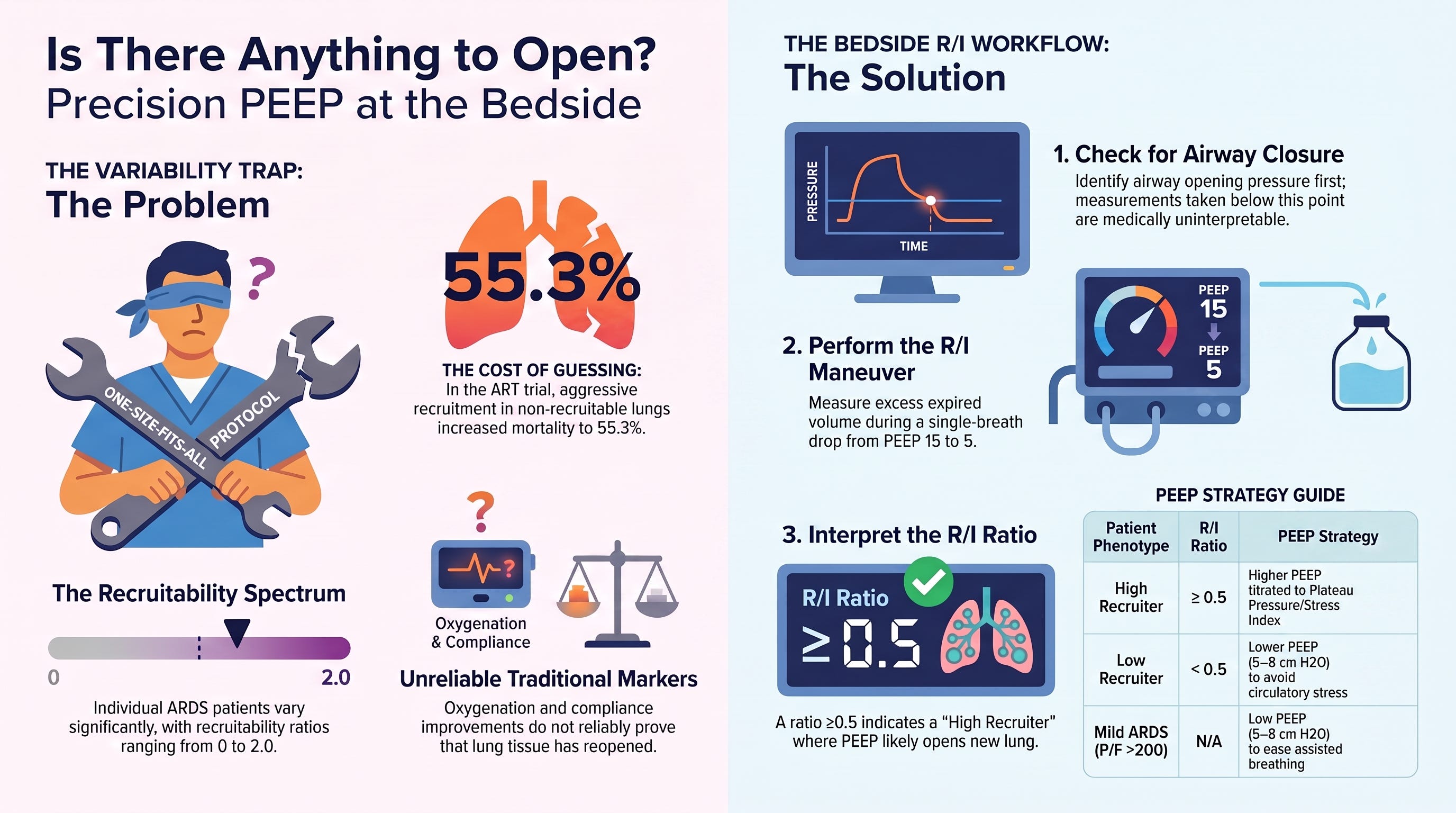
For twenty years the PEEP literature has asked the wrong question. ALVEOLI, EXPRESS, and LOVS all asked whether higher PEEP beats lower PEEP, and all landed on neutral. Then ART asked whether a maximal recruitment maneuver followed by compliance-titrated PEEP beats low PEEP, and the answer was worse than neutral. Twenty-eight day mortality was 55.3 percent in the intervention arm and 49.3 percent in the control arm, and six-month mortality was higher too. A strategy built on sound physiology killed people.
The reason those trials keep failing is visible in a paper published two decades ago. In 2006, Luciano Gattinoni and colleagues put 68 ARDS patients through whole-lung CT at airway pressures of 5, 15, and 45 cm H2O and measured how much lung actually reopened. Their conclusion was that the percentage of potentially recruitable lung is extremely variable and strongly associated with the response to PEEP. Some patients had large volumes of collapsed lung waiting to be opened. Others had almost none. And we have been giving both groups the same PEEP.
Think about what that does to a trial. Enroll a hundred patients, half of whom will benefit from high PEEP because they have recruitable lung, and half of whom will be harmed by it because they do not and the pressure simply overdistends the small amount of aerated tissue they have left. The benefit and the harm cancel. The trial reads neutral. And if the intervention is aggressive enough, as it was in ART, the harm wins outright.
This is a problem every discipline at the bedside can act on, because the measurement is executable today. It requires no CT scanner, no research protocol, and no equipment that a modern ICU does not already own.
The Study / Evidence in Context
The anchor review lays out a framework, and the framework rests on a measurement that became practical in 2020.
Lu Chen, Lorenzo Del Sorbo, Domenico Luca Grieco, Laurent Brochard and colleagues published a clinical trial in the American Journal of Respiratory and Critical Care Medicine validating a single-breath method for estimating how much lung a given PEEP actually recruits. The idea is elegant. Ventilate the patient at PEEP 15, then abruptly release PEEP to 5 over a single breath. The volume that comes out is larger than what the compliance at low PEEP predicts it should be, and that excess volume is the volume that PEEP had been holding open. Divide that recruited volume by the effective pressure change and you have the compliance of the recruited lung. Divide that by the compliance of the respiratory system at low PEEP, which is the compliance of the baby lung, and you have the recruitment-to-inflation ratio.
The number tells you where PEEP is going. A high R/I ratio means the pressure is opening new lung. A low R/I ratio means the pressure is being distributed into the baby lung that was already open, which is another way of saying it is overdistending tissue rather than recruiting it.
In their cohort of 45 ARDS patients, the recruited volume measured by the single-breath technique correlated strongly with the multiple pressure-volume curve reference method, with an R-squared of 0.798 and a small bias of about 21 mL. The median R/I ratio was 0.5, and the range ran from 0 to 2.0, which is itself a striking confirmation of Gattinoni’s point. Some patients in the same diagnostic category had four times the recruitability of others. Patients above the median, the high recruiters, had better oxygenation at PEEP 15. Patients below it, the low recruiters, had lower systolic arterial pressure at PEEP 15. The same PEEP, applied to two patients with the same diagnosis, opened one lung and squeezed the other one’s circulation.
The consequences of recruitability reach further than oxygenation. Cappio Borlino and colleagues showed in 2024 in AJRCCM that whether PEEP raises or lowers pulmonary vascular resistance depends on recruitability. Grieco and colleagues showed in Critical Care in 2026 that recruitability determines whether PEEP increases or decreases mechanical power. Lai and colleagues showed in 2024 that the respiratory response to prone positioning differs according to the R/I ratio, and Del Sorbo and colleagues showed in 2023 that R/I itself changes when you turn a patient prone. Recruitability is not a curiosity. It sits underneath the oxygenation response, the hemodynamic response, the mechanical power, and the response to proning.
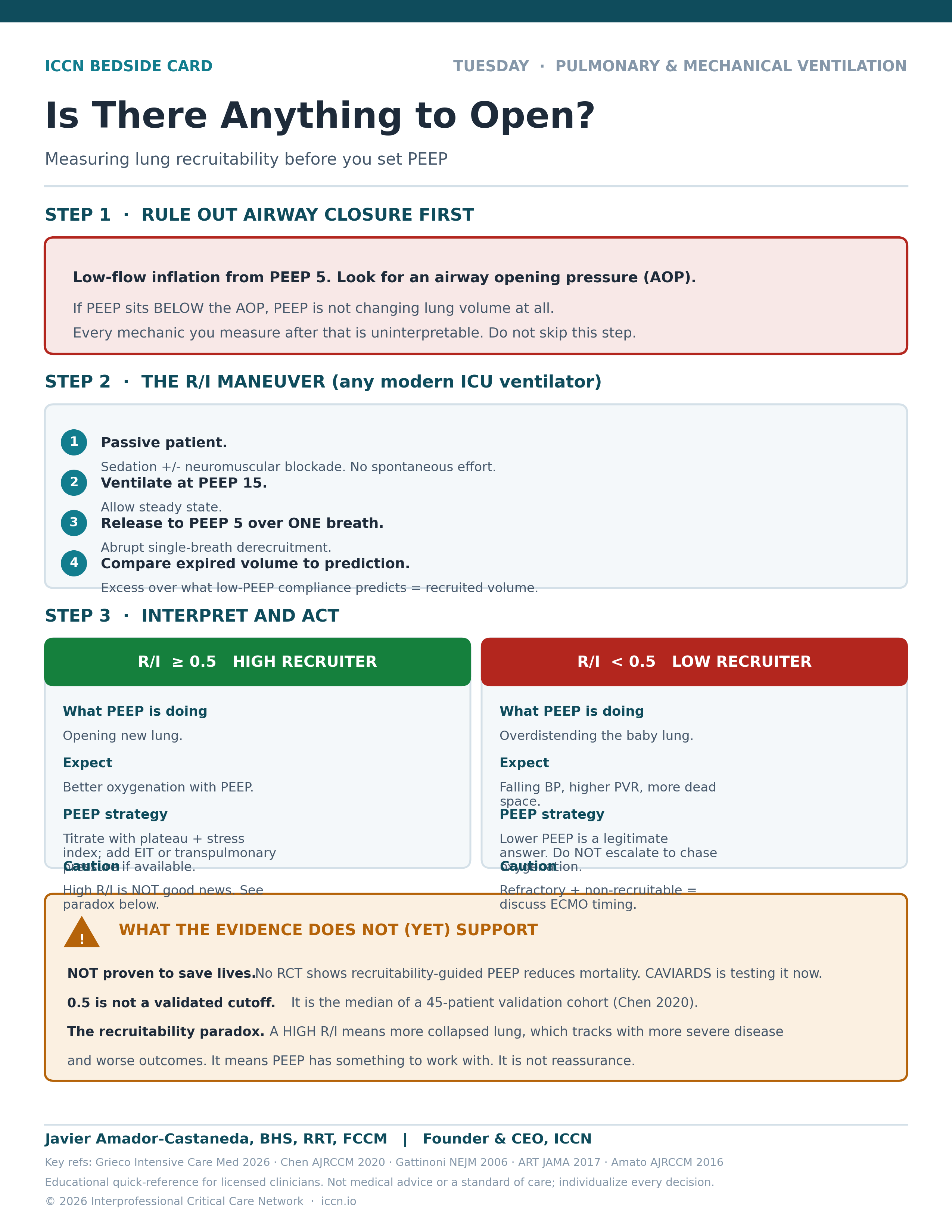
There is a trap, and it is the most important practical thing in this article. Chen and colleagues also described, in a 2018 AJRCCM letter, a phenomenon they called underestimated and misinterpreted: complete airway closure. In a meaningful fraction of ARDS patients, and Coudroy and colleagues showed in 2020 that the prevalence relates to body mass index, the small airways collapse completely at end-expiration. Below a certain pressure, the airway opening pressure, the ventilator is pressurizing a closed system. Nothing reaches the alveoli. If your PEEP is below the airway opening pressure, then PEEP is not changing lung volume at all, and every measurement of respiratory mechanics you make is uninterpretable. You must detect airway closure with a low-flow inflation before you measure anything else. A team that skips this step and reports an R/I ratio has produced a number that means nothing.
ART did not fail because opening the lung is the wrong idea. It failed because it opened everyone.
What Stood Out
1. The variability is the whole story. Gattinoni’s finding that recruitability is extremely variable, confirmed by the 0 to 2.0 range of R/I ratios in Chen’s cohort, is the fact that explains twenty years of disappointing PEEP trials. We have been running trials of a therapy that helps one phenotype and harms another, in populations that mix them together, and then concluding that the therapy does not work.
2. Our usual markers do not work at the individual level. This is the anchor review’s central claim, and it deserves to be uncomfortable. Oxygenation improves with PEEP for reasons that have nothing to do with recruitment, including reduced cardiac output and redistributed perfusion. Compliance can improve because you recruited lung or because you moved onto a better part of the pressure-volume curve. Driving pressure is a population-level survival signal that does not reliably tell you, in this patient, right now, whether the next 2 cm H2O of PEEP will open alveoli or crush capillaries. Grieco and colleagues made this argument directly in 2022, arguing that compliance and driving pressure may be inappropriate targets for setting PEEP.
3. The measurement is executable by an RT in a few minutes. The R/I maneuver needs a passive patient, a low-flow inflation to check for airway closure, and a single-breath PEEP drop from 15 to 5. It runs on any modern ICU ventilator. This is not a research technique that requires a physiology lab. It is a bedside test that most units could start doing this month.
4. The hemodynamics are a warning sign hiding in plain sight. Chen’s low recruiters dropped their blood pressure at PEEP 15. If you have ever raised PEEP and watched the pressure sag and reached for a vasopressor, you may have been treating the consequence of overdistending a lung that had nothing left to open. The nurse at the bedside sees this before the blood gas does.
5. The framework that follows is simple. The anchor review proposes something a team can actually use. Patients with a PaO2/FiO2 ratio above 200 are unlikely to have much collapsed lung available for recruitment, obesity aside, and can generally be managed with lower PEEP in the range of 5 to 8 cm H2O, which also makes the transition to assisted breathing easier. Patients at or below 200 are the ones in whom recruitability should actually be assessed, with airway closure accounted for first. Those with meaningful recruitability get PEEP titrated with global measures such as plateau pressure and the stress index, integrated with regional monitoring such as electrical impedance tomography or transpulmonary pressure where those are available. Those without meaningful recruitability get lower PEEP, because for them higher PEEP is mostly stress with no reward.
We have spent twenty years arguing about how much PEEP to give without first asking whether there is anything there to open.
Physiologic, Clinical, Leadership, or Ethical Interpretation
Here is my read, and it connects the last three Tuesdays into a single argument.
Two weeks ago, in the endotype article, I argued that knowing whether ARDS came from the lung or from the bloodstream does not reliably tell you how that lung will recruit, and that the honest move is to measure the individual lung rather than infer it from the admission diagnosis. Last week, in the collaboration with Gary Nieman, the argument was that the open-lung trials may have failed on their tools rather than on their idea. Both of those arguments have the same hole in the middle, and this week fills it. If you are going to individualize, you need a measurement. If you are going to open the lung, you need to know whether this lung opens. The recruitment-to-inflation ratio is the first practical, ventilator-executable answer to that question that the field has produced.
Notice what the 2026 framework is really doing. It is not proposing a new ventilator setting. It is inserting a diagnostic step before the setting. That is a different kind of change, and it is the change that precision medicine actually looks like in practice. You do not personalize by picking a fancier number. You personalize by measuring the patient before you choose the number.
For the interprofessional team, the workflow distributes cleanly.
The respiratory therapist is the person who performs the measurement. The low-flow inflation to detect airway closure, the single-breath PEEP release, the calculation, the recognition of a tracing that does not look right. This is a genuinely new competency and it belongs to RT, because RT is at the ventilator and RT owns the maneuvers. An RT who can hand the intensivist an R/I ratio and an airway opening pressure has changed the quality of the PEEP decision more than any table ever could.
The intensivist interprets the number and owns the strategy. The discipline here is to accept that a low R/I is an answer, not a failure. A poorly recruitable patient is not a patient who needs to be pushed harder. The temptation to escalate PEEP in a hypoxemic patient who is not recruiting is exactly the temptation that ART indulged, and it is the one this measurement exists to restrain.
The nurse watches what the pressure does to the circulation. In the poorly recruitable patient, PEEP does not open lung and it does compress the heart and the pulmonary vasculature. The falling blood pressure, the rising vasopressor requirement, the patient who looks worse after a PEEP increase, these are the bedside signals of a lung that had nothing to give. The nurse is the first to see them and should be empowered to say so out loud.
The pharmacist supports the measurement and its consequences. The R/I maneuver requires a passive patient, which means the sedation and neuromuscular blockade plan is part of the workflow rather than an afterthought. And when PEEP is escalated in a poorly recruitable patient, the vasopressor requirement climbs, which means the pharmacist is often looking at the pharmacologic shadow of a ventilator decision.
The APP carries the phenotype forward. Recruitability is not a fixed trait. It changes as edema resolves, as consolidation organizes, as the disease evolves. An R/I ratio measured on day one and never revisited becomes a stale label that the team keeps obeying. The APP who documents the measurement, the date, and the plan to repeat it is what keeps a personalized strategy from calcifying into a slogan.
The perfusionist enters at the boundary. The patient who is profoundly hypoxemic and demonstrably non-recruitable is a patient for whom the ventilator has run out of safe options, and that is the conversation about extracorporeal support. Recruitability assessment does not replace that conversation. It sharpens the timing of it, by telling the team early that escalating pressure is not going to rescue this lung.
Bedside / Workplace Takeaways
1. Check for airway closure before you measure anything. Perform a low-flow inflation from PEEP 5 and look for an airway opening pressure. If PEEP sits below the airway opening pressure, PEEP is not changing lung volume and every mechanical measurement you make is uninterpretable. This step comes first, always.
2. Measure the recruitment-to-inflation ratio in the passive, hypoxemic patient. Ventilate at PEEP 15, release abruptly to PEEP 5 over a single breath, and compare the expired volume with what compliance at low PEEP predicts. The excess is the recruited volume. This runs on any modern ICU ventilator.
3. Read the number as a direction, not a verdict. An R/I at or above roughly 0.5 suggests PEEP is opening lung. Below that, PEEP is mostly distributing into the baby lung. Remember this threshold is the median from a 45-patient validation cohort, not an outcome-validated cutoff.
4. In the poorly recruitable patient, resist the urge to escalate. Higher PEEP in a lung with nothing to open produces overdistension, dead space, higher pulmonary vascular resistance, and a falling blood pressure, with no recruitment to justify any of it. Lower PEEP is a legitimate and defensible answer.
5. In the patient with a PaO2/FiO2 above 200, do not reach for high PEEP by reflex. These patients are unlikely to have substantial recruitable collapse, and lower PEEP in the 5 to 8 cm H2O range is reasonable, with obesity as the notable exception. Lower PEEP also eases the transition to assisted breathing.
6. Watch the circulation during the PEEP change. A blood pressure that sags when PEEP goes up is physiologic information, not just a nuisance. In the poorly recruitable lung it may be the most honest signal you get.
7. Use the other tools where you have them. Electrical impedance tomography, validated for recruitment assessment in the multicenter RECRUIT study, and lung ultrasound, which Bouhemad and colleagues showed can quantify PEEP-induced re-aeration at the bedside, both add regional information that a global number cannot provide. CT remains the reference standard and remains impractical for most patients.
8. Re-measure as the disease evolves. Recruitability on day one is not recruitability on day four. A phenotype that is never re-checked becomes a label the team obeys long after it stopped being true.
Teaching Pearl
The next time you stand in front of a hypoxemic ARDS patient and someone suggests turning up the PEEP, ask a question before you touch the dial. Is there anything in this lung to open. If the team cannot answer that, then the PEEP change is a guess, and roughly half the time a guess in this situation is a guess that stretches an already open baby lung, raises the pressure in a struggling right ventricle, drops the blood pressure, and recruits nothing at all. Then ask the second question, which is whether the airway is even open below the PEEP you are setting, because if it is closed you have not been ventilating what you thought you were ventilating.
Teach your fellows and your respiratory therapists that PEEP is not a dose. It is a therapy with a responder phenotype and a non-responder phenotype, and there is a bedside test that tells you which one you are looking at. The clinician who measures before setting is practicing a different kind of medicine from the clinician who titrates to a table.
What We Should Not Over-Assume
This article is about a measurement, and the discipline it demands is being precise about what the measurement has and has not been shown to do.
We should not assume that recruitability-guided PEEP improves survival. It has not been shown to. There is no randomized trial demonstrating that setting PEEP according to a measured R/I ratio reduces mortality compared with usual care. The physiologic case is strong, the measurement is validated against a physiologic reference standard, and the outcome evidence does not exist yet. The CAVIARDS international multicentre randomised basket trial, whose protocol was published in 2026 by Coudroy, Telias, Jonkman and colleagues, is one of the studies that will test personalized approaches of this kind. Until trials like it report, recruitability-guided PEEP is a physiologically grounded strategy and not a proven therapy, and this article should be read in exactly that light.
We should not assume the 0.5 threshold is a validated decision boundary. It is the median value from Chen’s original 45-patient cohort. It is useful for orientation. It has not been shown, in an outcome trial, to be the point at which a treatment decision should flip.
We should not assume that a high R/I is good news. This is the recruitability paradox that Amato and Santiago named in 2016, and it catches clinicians constantly. Greater recruitability tends to accompany more collapsed lung, which tends to accompany more severe disease and worse outcomes. A high R/I tells you that PEEP has something to work with. It does not tell you the patient is doing well. Reading a high R/I as reassurance is a serious misreading.
We should not assume the measurement is trivial to perform correctly. It requires a passive patient, correct detection of airway closure, and a ventilator maneuver performed cleanly. Studies have raised questions about how accurately different ICU ventilators reproduce the calculation. A number produced carelessly is worse than no number, because it carries false authority.
And we should not forget the LIVE trial. Personalizing ventilation based on a misclassified phenotype was associated with substantially worse outcomes than not personalizing at all. Every argument for individualized ventilation carries that shadow. The accuracy of the measurement is not a detail. It is the entire foundation.
Limitations
The anchor is a narrative review rather than a systematic one, which is the appropriate format for synthesizing physiology and framework but which carries less evidentiary weight than a meta-analysis. The R/I validation cohort was 45 patients at a small number of centers. Much of the supporting recruitability literature is observational, physiologic, or drawn from COVID-19 ARDS cohorts whose generalizability to other ARDS phenotypes is debated. The comparison methods themselves are imperfect, since CT remains the reference standard for recruitment and CT is neither repeatable nor practical in most patients. Electrical impedance tomography and lung ultrasound each measure something related to but distinct from what CT and the R/I ratio measure, and the field has not settled on how to reconcile them when they disagree. Most importantly, the entire framework rests on the assumption that matching PEEP to measured recruitability will improve outcomes, and that assumption is currently untested in a randomized trial with a clinical endpoint.
Bottom Line
Twenty years of PEEP trials have produced neutral results and one clearly harmful one, and the most coherent explanation is that we have been asking how much PEEP without first asking whether there is anything to open. Recruitability varies enormously between patients who carry the identical diagnosis, and the markers we habitually use to judge PEEP response are unreliable in the individual. The recruitment-to-inflation ratio is a validated, ventilator-executable bedside measurement that tells you where PEEP is actually going, provided you check for airway closure first. Whether setting PEEP by that measurement will save lives is not yet known, and the trials that will tell us are running now. What is available today is better than what most units are doing today, which is guessing. Measure the lung. Then choose the number.
Javier Amador-Castaneda, BHS, RRT, FCCM | Founder & CEO, ICCN

References
Grieco DL, Coudroy R, Jonkman AH, et al. PEEP and alveolar recruitment after 60 years of acute respiratory distress syndrome. Intensive Care Med. 2026. doi:10.1007/s00134-026-08511-5
Chen L, Del Sorbo L, Grieco DL, et al. Potential for lung recruitment estimated by the recruitment-to-inflation ratio in acute respiratory distress syndrome. A clinical trial. Am J Respir Crit Care Med. 2020;201(2):178-187. doi:10.1164/rccm.201902-0334OC
Gattinoni L, Caironi P, Cressoni M, et al. Lung recruitment in patients with the acute respiratory distress syndrome. N Engl J Med. 2006;354(17):1775-1786. doi:10.1056/NEJMoa052052
Writing Group for the Alveolar Recruitment for Acute Respiratory Distress Syndrome Trial (ART) Investigators; Cavalcanti AB, Suzumura EA, Laranjeira LN, et al. Effect of lung recruitment and titrated positive end-expiratory pressure (PEEP) vs low PEEP on mortality in patients with acute respiratory distress syndrome: a randomized clinical trial. JAMA. 2017;318(14):1335-1345. doi:10.1001/jama.2017.14171
Chen L, Del Sorbo L, Grieco DL, et al. Airway closure in acute respiratory distress syndrome: an underestimated and misinterpreted phenomenon. Am J Respir Crit Care Med. 2018;197(1):132-136. doi:10.1164/rccm.201702-0388LE
Coudroy R, Vimpere D, Aissaoui N, et al. Prevalence of complete airway closure according to body mass index in acute respiratory distress syndrome: pooled cohort analysis. Anesthesiology. 2020;133(4):867-878. doi:10.1097/ALN.0000000000003444
Jonkman AH, Alcala GC, Pavlovsky B, et al. Lung recruitment assessed by electrical impedance tomography (RECRUIT): a multicenter study of COVID-19 acute respiratory distress syndrome. Am J Respir Crit Care Med. 2023;208(1):25-38. doi:10.1164/rccm.202212-2300OC
Bouhemad B, Brisson H, Le-Guen M, et al. Bedside ultrasound assessment of positive end-expiratory pressure-induced lung recruitment. Am J Respir Crit Care Med. 2011;183(3):341-347. doi:10.1164/rccm.201003-0369OC
Amato MBP, Santiago RRDS. The recruitability paradox. Am J Respir Crit Care Med. 2016;193(11):1192-1195. doi:10.1164/rccm.201601-0178ED
Cappio Borlino S, Hagry J, Lai C, et al. The effect of positive end-expiratory pressure on pulmonary vascular resistance depends on lung recruitability in patients with acute respiratory distress syndrome. Am J Respir Crit Care Med. 2024;210(7):900-907. doi:10.1164/rccm.202402-0383OC
Grieco DL, Collino F, Steinberg I, et al. Lung recruitability determines the impact of PEEP on mechanical power in ARDS. Crit Care. 2026. doi:10.1186/s13054-026-05843-y
Lai C, Shi R, Jelinski L, et al. Respiratory effects of prone position in COVID-19 acute respiratory distress syndrome differ according to the recruitment-to-inflation ratio: a prospective observational study. Ann Intensive Care. 2024;14(1):146. doi:10.1186/s13613-024-01375-2
Del Sorbo L, Tisminetzky M, Chen L, et al. Association of lung recruitment and change in recruitment-to-inflation ratio from supine to prone position in acute respiratory distress syndrome. Crit Care. 2023;27(1):140. doi:10.1186/s13054-023-04428-3
Grieco DL, Bongiovanni F, Dell’Anna AM, Antonelli M. Why compliance and driving pressure may be inappropriate targets for PEEP setting during ARDS. Crit Care. 2022;26(1):234. doi:10.1186/s13054-022-04109-7
Coudroy R, Telias I, Jonkman A, et al. Careful ventilation in acute respiratory distress syndrome: the protocol of the CAVIARDS international multicentre randomised basket trial. BMJ Open. 2026;16:e115775. doi:10.1136/bmjopen-2025-115775
Constantin JM, Jabaudon M, Lefrant JY, et al. Personalised mechanical ventilation tailored to lung morphology versus low positive end-expiratory pressure for patients with acute respiratory distress syndrome in France (the LIVE study): a multicentre, single-blind, randomised controlled trial. Lancet Respir Med. 2019;7(10):870-880. doi:10.1016/S2213-2600(19)30138-9
Clinical Disclaimer
⚠️ Medical Disclaimer: The content published in ICCN is intended solely for educational and informational purposes for healthcare professionals. It does not constitute medical advice, clinical guidelines, or a standard of care, and should not be used as a substitute for the independent professional judgment of a licensed clinician. All clinical decisions must be individualized to the patient and made by qualified healthcare providers. ICCN assumes no liability for any clinical outcomes arising from the information presented herein.
© 2026 Interprofessional Critical Care Network (ICCN). All rights reserved. Unauthorized reproduction or redistribution of this content is prohibited. Subscribers may share excerpts with proper attribution to ICCN and the author.