

The Right Idea With the Wrong Tools
Why a Failed Trial May Have Been Right About the Lung and Wrong Only About the Method

A guest collaboration with Gary F. Nieman, Department of Surgery, SUNY Upstate Medical University, whose group has spent decades studying the mechanics of ventilator-induced lung injury. The argument and framework are his. ICCN’s role was to sharpen the writing and verify the evidence.
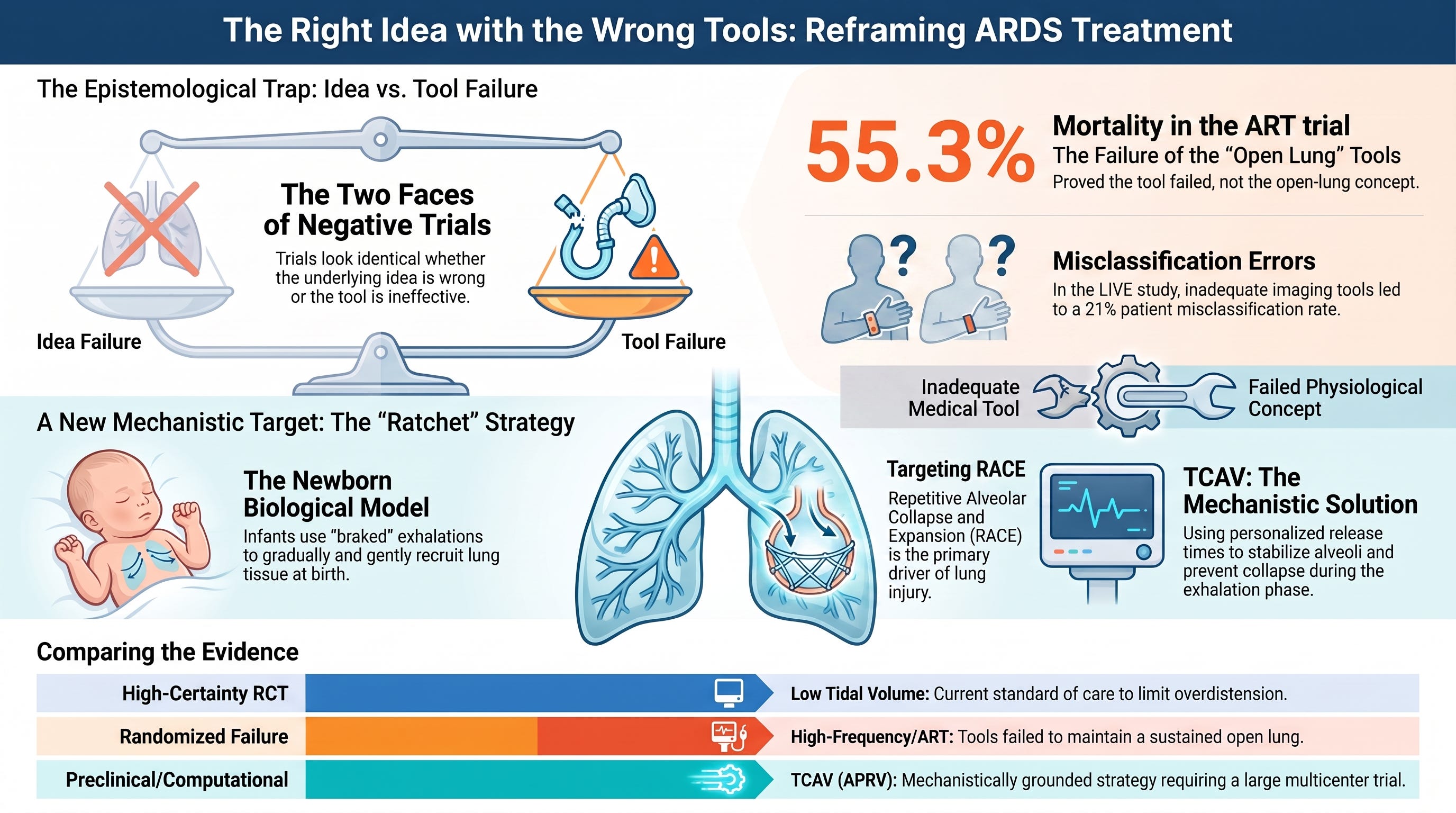
When the LIVE study reported that personalized mechanical ventilation tailored to lung morphology did not reduce mortality in ARDS, the result looked like a defeat for the whole idea of matching the ventilator to the lung. Then Silvia Mongodi and colleagues published an editorial with a title that reframed everything. They called it the right idea with the wrong tools. Their point was narrow and precise. The idea, that ventilation should be tailored to lung morphology, may be sound. The tools used to identify that morphology in LIVE, mostly chest radiographs rather than CT or ultrasound, and with a 21 percent misclassification rate, may simply have been inadequate to the task. A good idea can fail because it was tested with the wrong instrument. That single reframing raises a question that reaches far beyond one trial. Where else in critical care are we holding the right idea with the wrong tools, and mistaking a tool failure for an idea failure?
Why This Matters
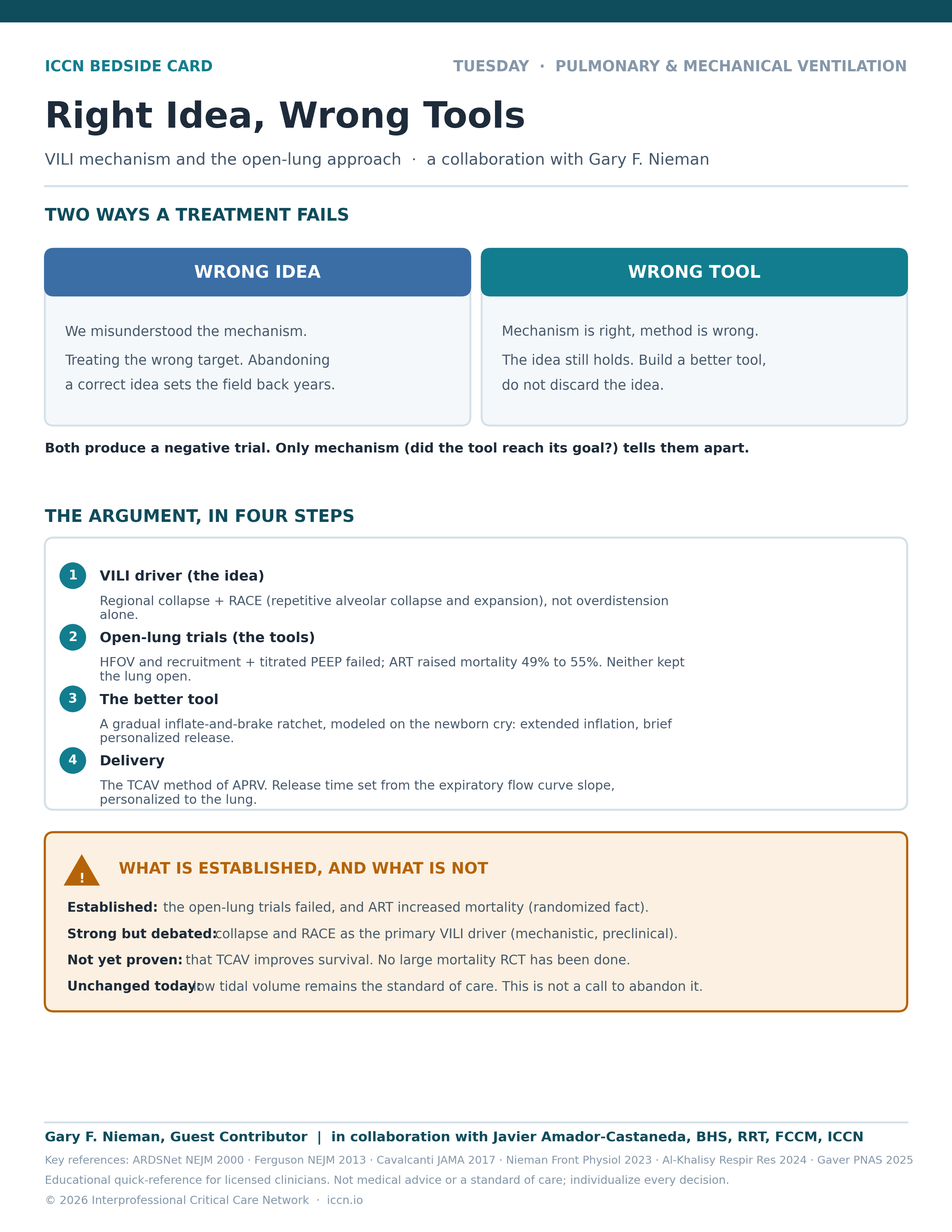
There are only two fundamental reasons a medical treatment fails. Either the underlying idea is wrong, meaning we have misunderstood the mechanism of the disease and are treating the wrong target, or the idea is right but the tool is wrong, meaning we understand the mechanism but have chosen an ineffective way to address it. These two failure modes look identical from the outside. Both produce a negative trial. But they could not be more different in their consequences. If we misdiagnose a tool failure as an idea failure, we abandon a correct understanding of the disease and set effective therapy back by years, sometimes decades. The history of ventilator-induced lung injury, the injury the ventilator inflicts on the very lung it is keeping alive, contains examples of both failure modes, and untangling them is the most important thing the field can do right now.
This matters to every discipline at the bedside because the stakes are mortality. ARDS remains a condition where a large fraction of patients die, and where the treatment itself, mechanical ventilation, can worsen the injury. If we have the mechanism of that injury wrong, then the way we set every ventilator in every ICU is aimed at the wrong target. If we have the mechanism right but the tool wrong, then the path forward is to build a better tool. The difference determines what the respiratory therapist sets, what the intensivist prescribes, and what the field spends the next decade studying.
The Evidence in Context
Consider first an example of what may be the wrong idea paired with the right tool. It is still widely taught that the primary way the ventilator injures the ARDS lung is by overdistending the small amount of remaining aerated tissue, the so-called baby lung. If overdistension of open tissue were truly the dominant mechanism, then the ARDSnet strategy of low tidal volume and limited airway pressure would be exactly the right tool, because it directly limits that overdistension. The landmark ARMA trial established low tidal volume ventilation as the standard of care, and it remains the standard today for good reason.
There are, in my view, three lines of evidence suggesting that overdistension of normal tissue is not the whole story, and may not be the primary one. First, ARDS mortality has not fallen as much as we hoped in the decades since low tidal volume ventilation was adopted, and by some accounts it remains stubbornly high. Second, there is an extensive body of work indicating that a major driver of VILI is regional lung collapse, which generates stress concentrations at the interfaces between open and closed tissue, and repetitive alveolar collapse and expansion, a phenomenon abbreviated RACE, which repeatedly injures the same vulnerable regions with every breath. Third, and most striking, controlled experiments show that even normal lung tissue can be ventilated at very high volumes and pressures without sustaining injury, provided there is not a large drop in pressure and volume during exhalation. That last finding is difficult to reconcile with a model in which pressure and volume themselves are the primary injurious agents. It points instead to the dynamic collapse and reopening during exhalation as the thing that does the damage.
Now consider the opposite failure mode, which is the heart of this article. Suppose the right idea is that VILI is driven by regional tissue collapse and RACE. If that is correct, then the open-lung approach, the strategy of reinflating collapsed tissue and holding it open so that it cannot repeatedly collapse and reopen, should be an effective tool. The concept has a long and respected lineage, captured decades ago in the phrase open up the lung and keep the lung open. So the field tested it. And here the story becomes instructive.
Three large trials attempted to open the lung and keep it open, and it is worth asking not just whether they improved mortality but whether they actually achieved a sustained open lung, judged by normalized respiratory system compliance and gas exchange. High-frequency oscillatory ventilation, tested in the OSCILLATE trial, did not reduce mortality and signaled possible harm. Recruitment maneuvers followed by titrated PEEP, tested in the large ART trial, actively increased mortality, with 28-day mortality of 55.3 percent in the intervention group versus 49.3 percent in the control group, and higher 6-month mortality as well. These are unambiguous trial facts, and they led a substantial part of the field to a reasonable conclusion, that the open-lung approach itself is the wrong idea.
There is another interpretation, and it is the one I want to argue for. It is at least as likely that the open-lung approach is the right idea, and that high-frequency oscillation and recruitment-maneuvers-plus-PEEP were the wrong tools. Neither of those methods reliably produced and sustained an open lung in the trials. A recruitment maneuver that transiently opens the lung and is then followed by a PEEP level that allows re-collapse has not kept the lung open. An oscillatory strategy that does not normalize compliance has not opened the lung in the sense that matters. If the tool never achieved the goal, then the trial did not actually test the idea. It tested the tool.
What Stood Out
A few points deserve emphasis, because they are where the argument turns.
First, a negative trial cannot distinguish a wrong idea from a wrong tool on its own. This is the central epistemological point, and it applies well beyond ventilation. When ART increased mortality, that result is entirely consistent with two very different conclusions: that opening the lung is harmful, or that this particular way of opening the lung is harmful while the goal remains sound. The trial cannot adjudicate between them. Only a mechanistic understanding of whether the tool achieved its physiologic goal can do that, and in ART and OSCILLATE, the evidence suggests the goal of a sustained open lung was not achieved.
The full-term newborn opens its fluid-filled lungs at birth with a gradual inflate-and-brake ratchet, not a single violent breath. Nature already showed us a gentle way to open a lung.
Second, the exhalation phase may matter more than the inflation phase. The experimental finding that normal lung tolerates high volumes and pressures without injury as long as exhalation is controlled reorients the entire injury model. It suggests that the dangerous moment in the breath is not the peak of inflation but the collapse during exhalation and the reopening on the next breath. If that is right, then a strategy built around controlling exhalation, rather than simply limiting inflation, is aimed at the actual mechanism.
Third, the newborn already solved this problem. The full-term newborn is born with fluid-filled lungs and must aerate them over the first breaths of life. It does so not with a single massive inflation but with a gradual, ratcheting process, a series of inflations with braked, incomplete exhalations that progressively recruit and stabilize lung tissue. This is a naturally evolved open-lung strategy, and it is gentle. It opens the lung a little at a time and does not let it fall back. That biological precedent is the conceptual model for a different kind of tool.
A negative trial tells you that a treatment failed. It does not tell you whether you had the wrong idea or simply the wrong tool. Confusing the two can set the field back by decades.
Physiologic, Clinical, Leadership, or Ethical Interpretation
Here is the argument in full, and here is where I need to be careful about what is established and what is proposed.
What is established is that the major open-lung trials did not achieve their goal and, in the case of ART, caused harm. What is a strong and well-supported mechanistic position, though still debated, is that regional collapse and RACE are major drivers of VILI, and that the injurious event is concentrated in the dynamic collapse and reopening of unstable lung units. What remains a hypothesis under active investigation, and what I want to be explicit about, is that a better tool can achieve the open lung safely and improve outcomes where the previous tools failed.
That better tool, in my group’s work and that of others, is a gradual inflate-and-brake ratcheting strategy, delivered through airway pressure release ventilation set by a specific method called time-controlled adaptive ventilation. The principle mirrors the newborn. An extended inspiratory phase at a fixed pressure gradually reopens a small amount of tissue with each breath. A very brief, personalized expiratory phase halts exhalation before the lung can collapse, which stabilizes the alveoli and prevents the repetitive collapse and reopening that drives RACE. Over hours, and sometimes days, densely collapsed regions are slowly ratcheted open and kept open. The expiratory duration is set from the patient’s own lung mechanics, read off the slope of the expiratory flow curve, which makes it personalized in the truest sense.
The evidence for this approach is substantial but it is important to characterize it accurately. It comes from direct microscopic observation of subpleural alveoli in animal models of ARDS, from head-to-head comparison against standard low tidal volume ventilation in translational animal models, from computational simulations of lung mechanics, and from energy analyses showing how conventional recruitment can concentrate injurious power in the lung. It is mechanistically coherent and preclinically strong. What it does not yet have is a large, multicenter, randomized trial with a mortality endpoint proving that it improves survival in humans. That trial has not been done. Until it is, the honest statement is that this is a mechanistically grounded, preclinically supported approach with the potential to reduce VILI, and not a proven mortality-reducing therapy. I hold that distinction firmly, because the entire argument of this article is about not confusing what we hope with what we have shown.
For the interprofessional team, this reframing changes the questions each discipline asks.
The respiratory therapist becomes the person who reads the lung’s own mechanics and sets the tool accordingly. Delivering a ratcheting open-lung strategy through APRV requires reading the expiratory flow curve, setting the release time from the patient’s physiology, and adjusting it as the lung changes over hours and days. This is a more physiologic and more demanding role than setting a fixed tidal volume, and it puts the RT at the center of the strategy.
The intensivist becomes responsible for holding the mechanistic distinction that this whole argument rests on. The intensivist who understands that the failed open-lung trials may have failed on the tool rather than the idea is the one who keeps an open mind about better tools, while still practicing the current standard of care where the evidence demands it. That is a hard intellectual balance, and it is the right one.
The nurse becomes the guardian against a specific and counterintuitive risk. When a ratcheting open-lung strategy succeeds, the lung can become so well recruited that the patient no longer meets the criteria for ARDS, an apparent cure. If that patient is then switched back to conventional ventilation, the lung can rapidly re-collapse. The nurse at the bedside is often the first to see the trajectory and to recognize that an improving lung on this strategy is not necessarily a lung that is ready for a different one.
The pharmacist becomes central because this approach permits and even benefits from spontaneous breathing, which changes the sedation strategy entirely. Managing sedation to allow safe spontaneous effort, rather than suppressing it, is a different pharmacologic problem, and it connects to the drive and effort questions this Tuesday series has covered before.
The APP becomes the keeper of continuity across a strategy that unfolds over days. A ratcheting recruitment that opens the lung slowly only works if the plan is sustained coherently across shifts, and the APP who documents the trajectory and the settings is what keeps a multi-day strategy from being undone in a single handoff.
The perfusionist enters for the patient in whom no ventilation strategy, old or new, can protect the lung. The refractory patient who cannot be opened or oxygenated is the one for whom extracorporeal support becomes the escape route, and recognizing that boundary is part of the same continuum of lung protection.
Bedside / Workplace Takeaways
Separate the idea from the tool when you read a negative trial. When a ventilation strategy fails in a trial, ask whether the tool actually achieved its physiologic goal before concluding the idea was wrong. ART and OSCILLATE did not achieve a sustained open lung, which means they tested their tools more than they tested the open-lung idea.
Keep practicing the current standard of care. Low tidal volume ventilation remains the evidence-based standard for ARDS, and nothing in this argument changes that today. The argument is about mechanism and about developing and testing a better tool, not about abandoning lung protection.
Watch the exhalation, not just the inflation. The mechanistic case points to dynamic collapse during exhalation and reopening on the next breath as a central injurious event. When you evaluate any ventilation strategy, consider what it does during exhalation, not only what it does at peak inflation.
Understand RACE as a target. Repetitive alveolar collapse and expansion is a mechanism you can aim at. Strategies that stabilize alveoli and prevent them from repeatedly collapsing and reopening are addressing a well-supported driver of VILI.
Know what TCAV is and what it is not. Time-controlled adaptive ventilation is a method of setting APRV that uses an extended inflation and a brief, personalized release to ratchet the lung open and keep it stable. It is mechanistically grounded and preclinically supported. It is not yet proven to reduce mortality in a large randomized trial, and it should be understood in that light.
If you use APRV, read the expiratory flow curve. The release time in the TCAV method is set from the slope of the expiratory flow curve, personalized to the patient’s lung. Setting it by a fixed number rather than by the patient’s physiology is not the same strategy.
Beware the apparent cure. A lung that becomes fully recruited on an open-lung strategy may no longer meet ARDS criteria, but switching it abruptly back to conventional ventilation can cause rapid re-collapse. Treat an open lung as something to maintain, not as a finished problem.
Demand the trial. The responsible next step for this approach is a large, multicenter, randomized trial with a mortality endpoint. Supporting and enrolling in that trial is how the field converts a compelling hypothesis into either a proven therapy or a well-tested negative, and either outcome is valuable.
Teaching Pearl
The next time a trial in your field reports a negative result, resist the reflex to discard the idea. Ask the harder question first. Did the treatment actually do what it was supposed to do at a physiologic level, and did it fail because the concept was wrong, or because the instrument was inadequate? A chest radiograph that misclassifies lung morphology in one patient out of five did not disprove the value of matching ventilation to morphology. A recruitment maneuver followed by a PEEP that lets the lung fall back did not disprove the value of an open lung. In both cases the tool, not the idea, may have been the point of failure. This distinction is not academic. It determines whether a field spends the next decade refining a good idea or abandoning it, and the cost of abandoning a correct idea is measured in years and in lives.
Teach your fellows, your respiratory therapists, and your trainees to hold this distinction. The most expensive error in medicine is not a failed treatment. It is a correct idea discarded because it was tested with the wrong tool.
What We Should Not Over-Assume
This article makes a provocative argument, and intellectual honesty requires being clear about its limits.
We should not assume that low tidal volume ventilation is wrong or should be abandoned. It is the current standard of care, supported by a landmark trial, and it saves lives compared with the high tidal volumes that preceded it. The argument here is that overdistension may not be the primary injury mechanism and that a better tool may exist, not that lung protection should be discarded. Any clinician who reads this as license to abandon low tidal volume ventilation has misread it.
We should not assume the mechanistic debate is settled. The claim that regional collapse and RACE, rather than overdistension, are the primary drivers of VILI is a strong and well-supported position, but it is a position in an active scientific debate, not a settled consensus. Serious investigators hold that overdistension and dynamic strain both contribute, and the relative weight is genuinely uncertain.
We should not assume that TCAV or any ratcheting open-lung strategy is proven to improve survival. It is not. The supporting evidence is mechanistic, preclinical, computational, and observational, and it is genuinely compelling at that level, but a large multicenter randomized trial with a mortality endpoint has not been completed. Preclinical strength does not guarantee clinical benefit, and the history of ARDS is full of approaches that were physiologically attractive and clinically disappointing. This approach deserves that definitive trial precisely because the argument for it is strong enough to justify one.
And we should not assume that the reasoning in this article, that negative trials confuse idea failure with tool failure, is a universal escape hatch. It is a legitimate and important distinction, but it can be misused to defend any failed idea indefinitely by always blaming the tool. The discipline is to demand that a proposed better tool be tested rigorously, not merely asserted to be better. That is why the call for a definitive trial is the honest endpoint of this argument.
Limitations
The evidence marshaled here spans very different levels of certainty, and they should not be blurred. The trial results, that ARMA established low tidal volume, that OSCILLATE and ART failed and ART caused harm, are high-certainty randomized evidence. The mechanistic model of collapse and RACE is supported by strong preclinical and computational work but remains a contested scientific position. The case for a ratcheting open-lung tool rests on animal models, direct alveolar imaging, computational simulation, and energy analysis, without a completed large randomized mortality trial in humans. Much of the supporting work on this specific approach comes from a relatively small group of investigators, including my own, which is a limitation that only broader, independent, randomized testing can address. This article is an argument for a hypothesis and a call for that testing, not a report of a proven therapy.
Bottom Line
The LIVE editorial asked whether personalized ventilation was the right idea with the wrong tools, and the question generalizes. The open-lung approach may be a right idea that has been repeatedly tested with the wrong tools, and the failed trials of high-frequency oscillation and recruitment-maneuvers-plus-PEEP may tell us more about those tools than about the idea. The mechanistic case that regional collapse and RACE drive VILI is strong, and it points toward a different kind of tool, a gradual inflate-and-brake ratcheting strategy modeled on how a newborn opens its lungs at birth, delivered through the TCAV method of APRV. That approach is mechanistically grounded and preclinically supported, and it is not yet proven to improve survival in a large randomized trial. Both of those statements are true at once, and holding them together is the point. Low tidal volume remains the standard of care today. The open-lung idea deserves a better tool and a definitive trial. And the field deserves the discipline to tell the difference between a wrong idea and a wrong tool, because that difference is measured in decades and in lives.
Gary F. Nieman, Guest Contributor | in collaboration with Javier Amador-Castaneda, BHS, RRT, FCCM, Founder & CEO, ICCN

Reference
Constantin JM, Jabaudon M, Lefrant JY, et al. Personalised mechanical ventilation tailored to lung morphology versus low positive end-expiratory pressure for patients with acute respiratory distress syndrome in France (the LIVE study): a multicentre, single-blind, randomised controlled trial. Lancet Respir Med. 2019;7(10):870-880. doi:10.1016/S2213-2600(19)30138-9
Acute Respiratory Distress Syndrome Network; Brower RG, Matthay MA, Morris A, Schoenfeld D, Thompson BT, Wheeler A. Ventilation with lower tidal volumes as compared with traditional tidal volumes for acute lung injury and the acute respiratory distress syndrome. N Engl J Med. 2000;342(18):1301-1308. doi:10.1056/NEJM200005043421801
Ferguson ND, Cook DJ, Guyatt GH, et al; OSCILLATE Trial Investigators and the Canadian Critical Care Trials Group. High-frequency oscillation in early acute respiratory distress syndrome. N Engl J Med. 2013;368(9):795-805. doi:10.1056/NEJMoa1215554
Writing Group for the Alveolar Recruitment for Acute Respiratory Distress Syndrome Trial (ART) Investigators; Cavalcanti AB, Suzumura EA, Laranjeira LN, et al. Effect of lung recruitment and titrated positive end-expiratory pressure (PEEP) vs low PEEP on mortality in patients with acute respiratory distress syndrome: a randomized clinical trial. JAMA. 2017;318(14):1335-1345. doi:10.1001/jama.2017.14171
Jain SV, Kollisch-Singule M, Satalin J, et al. The role of high airway pressure and dynamic strain on ventilator-induced lung injury in a heterogeneous acute lung injury model. Intensive Care Med Exp. 2017;5(1):25. doi:10.1186/s40635-017-0138-1
Gaver DP 3rd, Nieman GF, Gatto LA, Cereda M, Habashi NM, Bates JHT. The POOR get POORer: a hypothesis for the pathogenesis of ventilator-induced lung injury. Am J Respir Crit Care Med. 2020;202(8):1081-1087. doi:10.1164/rccm.202002-0453CP
Nieman GF, Herrmann J, Satalin J, Kollisch-Singule M, Andrews PL, Habashi NM, Tingay DG, Gaver DP, Bates JHT, Kaczka DW. Ratchet recruitment in the acute respiratory distress syndrome: lessons from the newborn cry. Front Physiol. 2023;14:1287416. doi:10.3389/fphys.2023.1287416
Al-Khalisy H, Nieman GF, Kollisch-Singule M, et al. Time-controlled adaptive ventilation (TCAV): a personalized strategy for lung protection. Respir Res. 2024;25(1):37. doi:10.1186/s12931-023-02615-y
Gaver DP 3rd, Kollisch-Singule M, Nieman G, Satalin J, Habashi N, Bates JHT. Mechanical ventilation energy analysis: recruitment focuses injurious power in the ventilated lung. Proc Natl Acad Sci U S A. 2025;122(10):e2419374122. doi:10.1073/pnas.2419374122
Clinical Disclaimer
⚠️ Medical Disclaimer: The content published in ICCN is intended solely for educational and informational purposes for healthcare professionals. It does not constitute medical advice, clinical guidelines, or a standard of care, and should not be used as a substitute for the independent professional judgment of a licensed clinician. All clinical decisions must be individualized to the patient and made by qualified healthcare providers. ICCN assumes no liability for any clinical outcomes arising from the information presented herein.
© 2026 Interprofessional Critical Care Network (ICCN). All rights reserved. Guest-contributed intellectual content remains the work of its author. Unauthorized reproduction or redistribution of this content is prohibited. Subscribers may share excerpts with proper attribution to ICCN and the authors.