

What 2026 Just Changed About Ventilating ARDS in the Patient With Obesity
A Founder Members Special Edition Article

Two new Intensive Care Medicine papers and a run of fresh trials rebuilt the playbook from preoxygenation to liberation. Here is the current evidence, the physiology, and the bedside plan for the whole team.
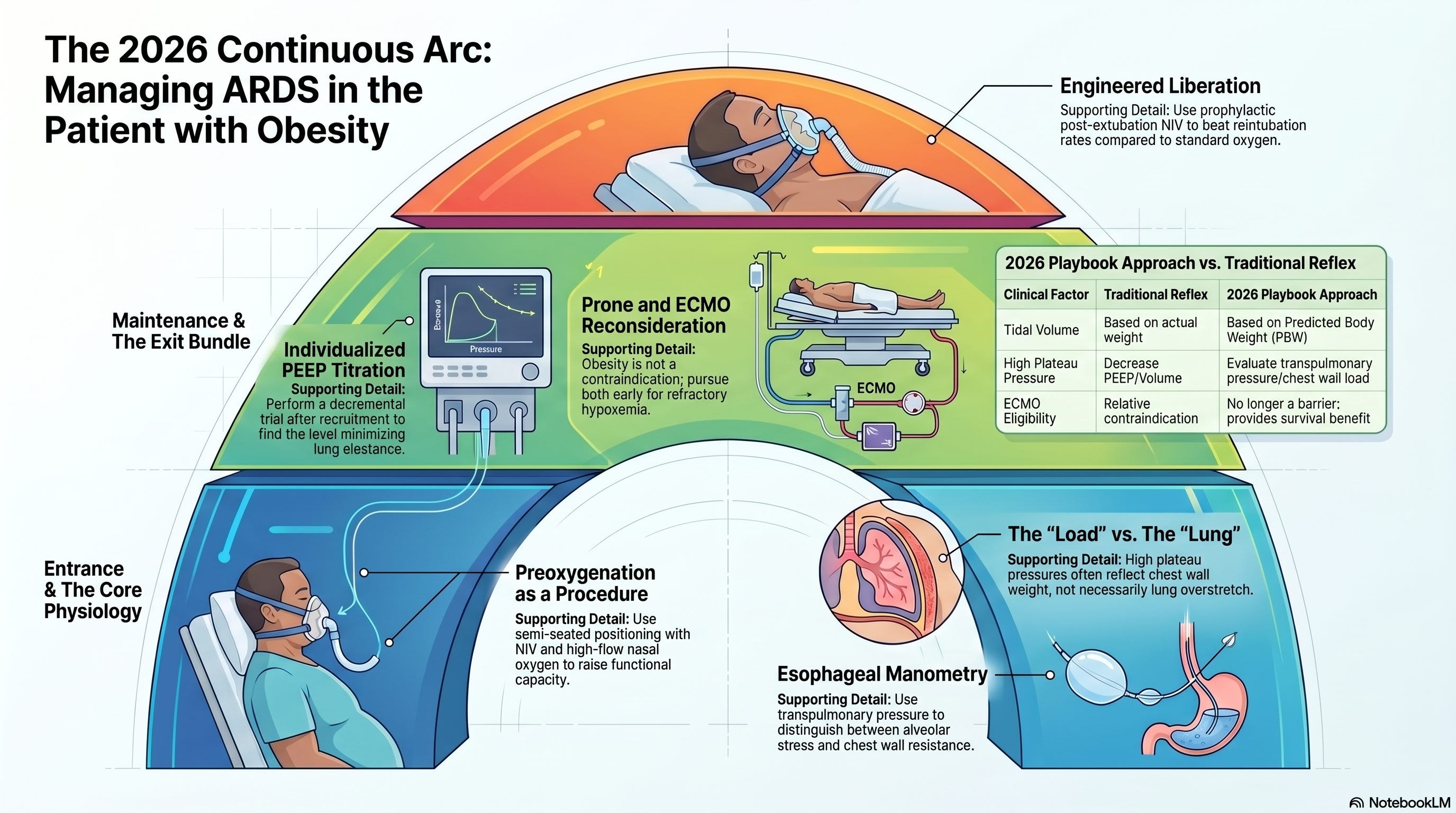
A 41 year-old with a BMI of 54 is intubated for severe hypoxemic ARDS. The plateau pressure reads 33 cmH2O and the driving pressure looks high. The reflex is to cut the tidal volume and back off the PEEP. In this patient, that reflex can be exactly wrong, and the literature that tells us why has moved faster in the last eighteen months than it did in the previous ten years. In 2026 alone, Intensive Care Medicine published both a focused update and a full narrative review devoted to this single problem, and they did not just refine the old advice. They reorganized the entire approach into one continuous arc, from the moment you preoxygenate to the morning you extubate.
This edition walks that arc with the current evidence in hand.
ICCN Update
The new ICCN website is live at iccn.io. Every article published in the past two weeks is now archived in one place, and our new Research section pulls recent published data from 26 major critical care and medical journals into a single curated feed for subscribers. Bookmark iccn.io.
Why This Matters
Obesity is now one of the most common phenotypes in the ICU, it raises the risk of developing ARDS, and it changes how nearly every ventilator number should be read. Yet the patients who set our defaults almost never resembled the patients who filled the trials that produced those defaults. The 2026 reviews say this plainly: most of what we apply to patients with obesity is still extrapolated from general ICU populations, and the gap between what we do and what we have actually tested in this group remains wide. That gap is where heavy patients quietly get undertreated by tables built for lighter ones. Closing it is not one setting. It is a habit of measuring, and it belongs to every discipline at the bedside.