

When Restraint Became the Intervention: Twenty-Five Years of Landmark Trials in Critical Care Nephrology
A chronological journey from the death of the renal-dose dopamine myth (2000) to the newest bicarbonate and prevention trials of 2025, and what each one changed at the bedside for every ICU discipline

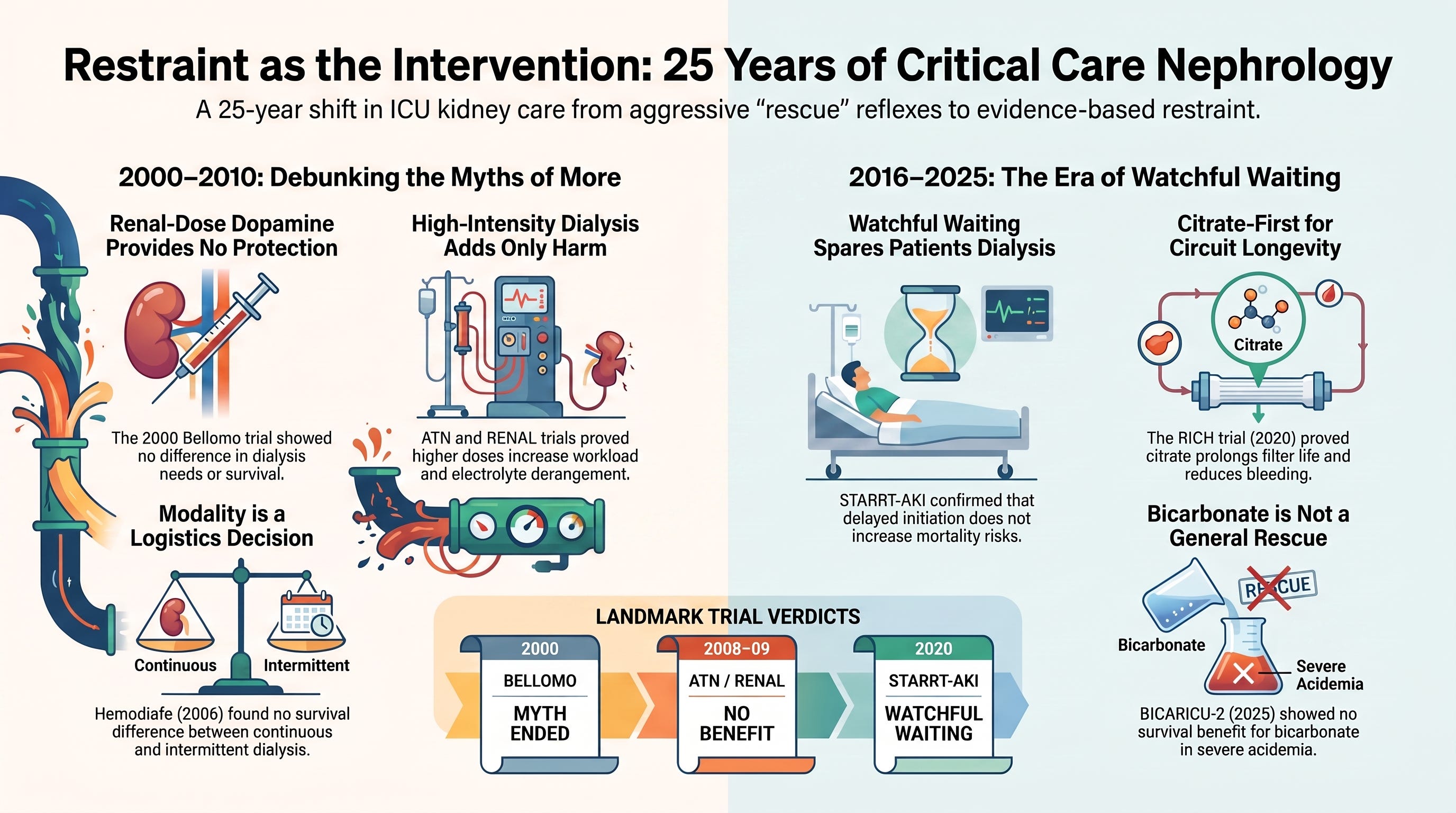
For most of critical care history, the reflex when a kidney faltered was to do more. Hang a dopamine infusion. Dialyze harder. Start earlier. Buffer the acid. Each move felt like taking action against a failing organ, and each move felt like care. Then, one trial at a time over twenty-five years, the field discovered something uncomfortable: most of those instincts were wrong. The kidney in critical illness did not need to be rescued harder. It needed to be supported carefully, and often, left alone to recover. This is the story of how critical care nephrology learned that restraint was the intervention all along.
ICCN Update
The new ICCN website is live at iccn.io. Every article published in the past two weeks is now archived in one place, and our new Research section pulls recent published data from 26 major critical care and medical journals into a single curated feed for subscribers. Bookmark iccn.io.
Why This Matters
Acute kidney injury is one of the most common and most lethal complications in the ICU, and its management touches every discipline on the unit. The intensivist deciding whether to start renal replacement therapy, the ICU and dialysis nurses running the circuit and watching the calcium, the critical care pharmacist building the citrate protocol and dosing the buffers, the advanced practice provider making the initiation call at the bedside overnight, the perfusionist whose extracorporeal expertise underlies both the bypass pump and the shared principles of the dialysis circuit, and the respiratory therapist managing the ventilatory cost of the acid we try to correct are all working off the same body of evidence. That evidence is unusually clear, and unusually humbling, because so much of it is negative. This piece is the map of what those trials actually proved, so that the restraint they call for is a defensible clinical position rather than a shrug.
“The kidney taught critical care a lesson the lung had to learn separately: the strongest intervention is often the one you choose not to make.”
The Trials in Context: A Journey From Oldest to Newest
Chapter 1. The First Correction: Ending a Ritual (2000)
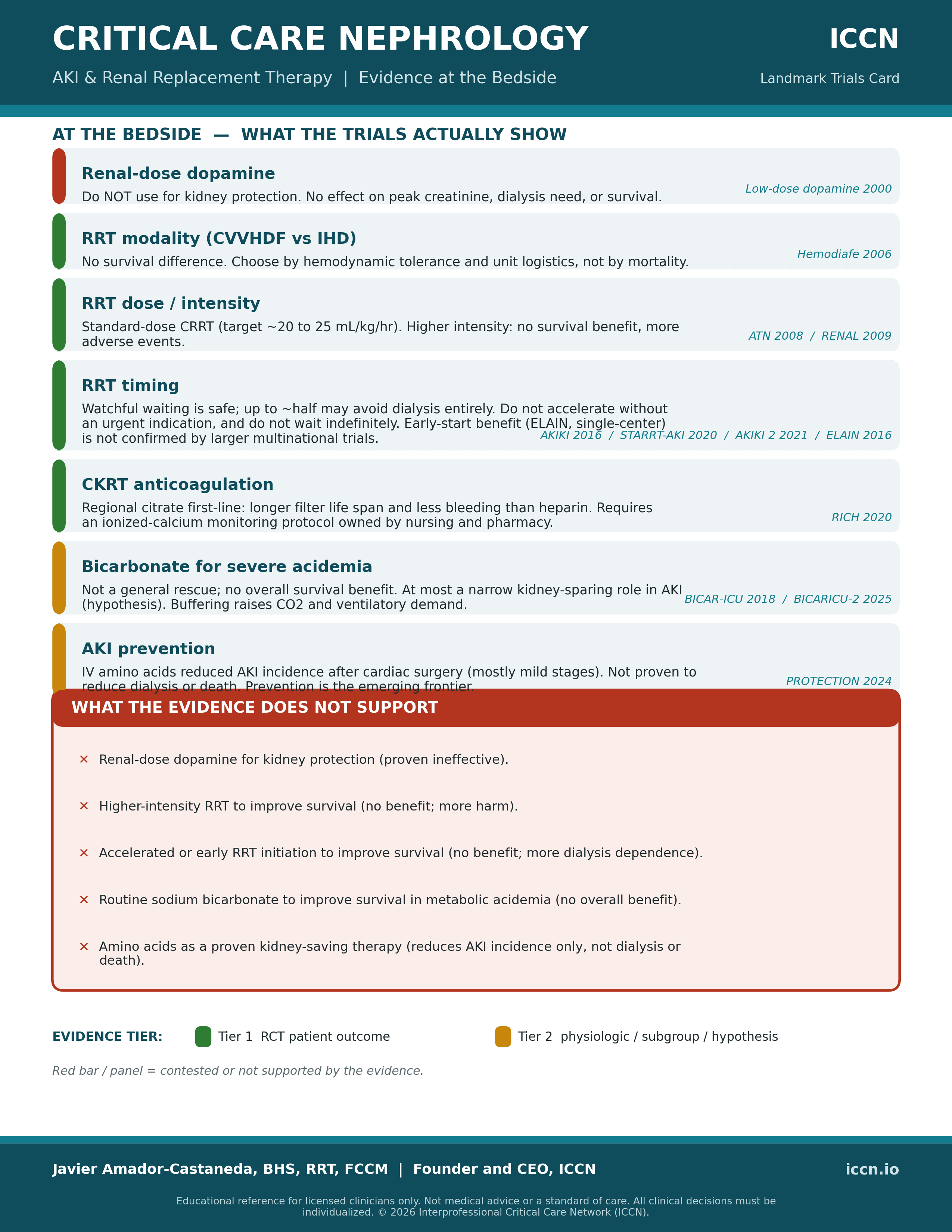
The modern era of evidence in critical care nephrology opens with a trial that took something away. For years, low-dose “renal-dose” dopamine was infused almost reflexively in the belief that it increased renal blood flow and shielded the kidney. In 2000, Bellomo and the ANZICS Clinical Trials Group tested that belief directly in the low-dose dopamine trial, randomizing patients with early renal dysfunction to dopamine or placebo. There was no protection: no meaningful difference in peak creatinine, in the need for dialysis, or in survival. A therapy that had felt physiologically obvious did nothing for the kidney. Pharmacists and nurses stopped hanging an infusion that carried real risks and no renal reward. The lesson that would echo for a quarter century arrived first: an intervention can be attractive on paper and useless at the bedside.
Chapter 2. How, and How Much (2006 to 2009)
With one myth retired, the field turned to the mechanics of renal replacement therapy, and asked two questions in sequence. First, does the modality matter? In 2006, the Hemodiafe trial compared continuous venovenous hemodiafiltration against intermittent hemodialysis in patients with acute renal failure and multiple-organ dysfunction, and found no difference in survival. Continuous therapy caused more hypothermia; intermittent therapy did not cause the excess hypotension many had feared. Modality became a decision about hemodynamic tolerance and unit logistics that nurses and intensivists make together, not a lever on mortality.
Then, does the dose matter? Two large trials answered within a year of each other. In 2008, the ATN trial compared intensive against less-intensive renal support and found no reduction in sixty-day mortality, with more metabolic and hemodynamic adverse events in the intensive arm. In 2009, the RENAL trial compared higher-intensity continuous therapy at 40 mL/kg/hr against 25 mL/kg/hr and again found no mortality benefit from the higher dose. Together they closed the intensity question at scale: standard-dose renal replacement is the target, and pushing the dose higher adds cost, workload, and electrolyte derangement without saving lives. For the respiratory therapists, dialysis nurses, and pharmacists who carry the operational burden of these circuits, that was permission to stop chasing a number.
“Two of the largest trials in the field spent enormous effort to prove that more dialysis is simply more dialysis.”
Chapter 3. The Great Timing Debate (2016 to 2021)
If modality and dose did not move survival, perhaps timing would, and this became the most contested question in critical care nephrology. In 2016, a single-center trial named ELAIN randomized critically ill patients with AKI, many after cardiac surgery, to early or delayed initiation guided by a biomarker, and reported lower mortality with early start. It was provocative and widely cited. In the same year, the multicenter AKIKI trial asked nearly the same question in a broader population and reached the opposite bedside conclusion: no survival difference between early and delayed strategies, and, strikingly, nearly half the patients in the delayed arm recovered enough that they never required dialysis at all. Watchful waiting spared a large fraction of patients an invasive procedure entirely.
The tie was broken in 2020 by the large multinational STARRT-AKI trial, which compared an accelerated strategy against a standard one and found no mortality benefit from moving early. The accelerated arm also carried downsides: more dependence on dialysis at ninety days and more adverse events. The following year, AKIKI 2 drew the far boundary, comparing a delayed strategy against an even-more-delayed one and finding that waiting longer still conferred no benefit and hinted at harm. Read together, and treating ELAIN as the single-center outlier it is against the multinational evidence, the field arrived at a defensible position: in the absence of an urgent conventional indication, watchful waiting is safe and spares many patients dialysis, but the waiting has a limit. This is one of the clearest cases in critical care where the largest, most rigorous trials overturned an appealing early signal.
Chapter 4. Keeping the Circuit Alive (2020)
Once a patient is on continuous therapy, the practical enemy is a clotted filter, and the choice of anticoagulant had long divided units. In 2020, the RICH trial compared regional citrate anticoagulation against systemic heparin during continuous kidney replacement therapy. Citrate significantly prolonged filter life span and reduced bleeding, though its effect on mortality was not conclusively established. This is the trial that lives closest to the hands of the bedside team. Regional citrate confines anticoagulation to the circuit by binding ionized calcium, which means dialysis and ICU nurses run a calcium-monitoring workflow and critical care pharmacists build and safeguard the citrate and calcium protocols that make it work. RICH, alongside guideline preference, moved many units toward citrate-first anticoagulation, an operational shift owned largely by nursing and pharmacy rather than by any single prescriber.
Chapter 5. The Chemistry of Rescue (2018 to 2025)
Severe metabolic acidemia is frightening at the bedside, and reaching for sodium bicarbonate has always been tempting. In 2018, the BICAR-ICU trial tested bicarbonate against no bicarbonate in critically ill patients with severe metabolic acidemia and found no improvement in its primary composite of death or organ failure across the whole population. A prespecified subgroup with acute kidney injury did appear to benefit, with less renal replacement therapy and a possible mortality signal, but that finding was hypothesis-generating rather than definitive. The trial also carried a lesson respiratory therapists know well: buffering acid generates carbon dioxide, which raises ventilatory demand and can complicate the very patient it aims to stabilize.
That AKI signal was worth chasing, and in 2025 the BICARICU-2 trial chased it, testing protocolized bicarbonate specifically in severe acidemia with moderate-to-severe AKI. The promising subgroup did not convert into a mortality win: there was no survival benefit. Bicarbonate did reduce and delay the use of kidney replacement therapy and improved a composite of major adverse kidney events, though that reduction is complicated to interpret because pH thresholds themselves drove the criteria for starting dialysis. The two-trial sequence is a compact tutorial in why a striking subgroup deserves a dedicated trial before it becomes practice.
Chapter 6. From Rescue to Prevention (2024)
Every trial so far concerns a kidney already injured. The newest chapter asks whether injury can be prevented at all. In 2024, the PROTECTION trial randomized adults undergoing cardiac surgery to an intravenous amino acid infusion or to Ringer’s solution, on the rationale that amino acids recruit the kidney’s functional reserve and increase perfusion. The infusion reduced the occurrence of postoperative AKI. It is the first large, positive pharmacologic prevention signal in this space, and it places perfusionists, who run the cardiopulmonary bypass circuit, alongside pharmacists and nurses at the center of a prevention strategy. The caution is real: the benefit fell mainly in the milder stages of AKI, without a clear reduction in dialysis or death. PROTECTION points the field from rescue toward prevention, which is the right direction, while reminding us that preventing a rise in creatinine is not yet the same as saving a kidney or a life.
What Stood Out
Three patterns run the length of this twenty-five-year arc. The first is that the overwhelming majority of these landmark trials are negative or show no difference, and that is the point rather than a disappointment. The second is that the durable lessons are lessons in restraint: do not give the useless drug, do not dialyze harder, do not start earlier, do not reflexively buffer. The third is that the interventions which did hold up, citrate for the circuit and amino acids for prevention, are owned by the bedside disciplines of nursing, pharmacy, and perfusion as much as by the prescriber.
Physiologic, Clinical, and Leadership Interpretation
Read end to end, this record describes a field growing out of its rescue reflex. The kidney injured in critical illness is often recovering on its own timeline, and the trials show, again and again, that aggressive intervention tends to add harm without adding benefit. For a leader building an interprofessional service, the operational implication is sharp. The evidence base here does not reward heroics; it rewards disciplined, protocolized restraint executed reliably by the whole team. The competitive advantage of a modern ICU in AKI care lies less in how aggressively it can intervene and more in how consistently it can hold a defensible line: standard-dose therapy, watchful-waiting initiation with a defined ceiling, citrate-first circuits, and buffering reserved for the narrow situations where it earns its place.
Bedside / Workplace Takeaways
Retire the reflex interventions permanently. Renal-dose dopamine is settled: it does not protect the kidney. Audit your unit for any lingering reflexive practices that persist on physiology rather than evidence.
Set standard-dose renal replacement as the default and defend it. ATN and RENAL show higher intensity adds workload, cost, and electrolyte derangement without survival benefit. Make the standard dose the protocolized target for nursing, pharmacy, and respiratory therapy.
Adopt watchful waiting for initiation, with an explicit ceiling. AKIKI, STARRT-AKI, and AKIKI 2 support delaying dialysis in the absence of an urgent indication, which spares many patients the procedure, while AKIKI 2 warns against waiting indefinitely. Give your APPs and intensivists a written trigger set.
Make citrate anticoagulation a nursing and pharmacy protocol, not an ad hoc order. RICH supports regional citrate for longer filter life and less bleeding. Its safety depends on a calcium-monitoring workflow owned by dialysis and ICU nurses and a protocol safeguarded by pharmacy.
Reserve bicarbonate and treat prevention as the frontier. BICAR-ICU and BICARICU-2 show buffering is not a general rescue and offers, at most, a narrow kidney-sparing role. PROTECTION suggests prevention is where the next gains lie, with perfusion, pharmacy, and nursing at the center.
Teaching Pearl
The most teachable idea in this entire record is that a negative trial is not a failed trial. AKIKI’s most important number was not a p value; it was the near-half of the delayed-strategy patients who never needed dialysis at all, because they were given time to recover. Use that figure in your next fellowship session, dialysis-nurse in-service, or interprofessional huddle. It reframes watchful waiting from passive to active, and it teaches the whole team that withholding an intervention is itself a considered clinical act.
What We Should Not Over-Assume
Restraint is not the same as inaction, and the evidence has boundaries. Watchful waiting does not mean waiting forever, which is precisely what AKIKI 2 clarified. The ELAIN signal for early initiation, while outweighed by larger trials, is a reminder that specific populations, such as certain post-cardiac-surgery patients, may behave differently, and these questions are not fully closed. PROTECTION reduced the incidence of AKI but has not yet been shown to reduce dialysis or death, so it should not be read as a proven kidney-saving therapy. And BICARICU-2’s reduction in dialysis use is genuinely difficult to interpret, because the acid-base criteria that defined the outcome were entangled with the intervention itself. These trials set the floor of reasoning, not the ceiling.
Limitations
This is a curated arc rather than a systematic review, and reasonable experts would add trials at the margins, including the sepsis-specific timing and high-volume hemofiltration literature. The set concentrates on renal replacement therapy, acid-base management, and prevention, and does not cover the full breadth of AKI biomarkers, nephrotoxin stewardship, or fluid management, each of which deserves its own treatment. Finally, several of these trials enrolled across many prior years, so the dates mark when the field learned, not when the work was done.
Bottom Line
Twenty-five years of landmark trials in critical care nephrology tell a single, disciplined story: the injured kidney is rarely helped by intervening harder, and is often helped most by careful support and time. The reflexes the field abandoned, the useless drug, the higher dose, the earlier start, and the automatic buffer, were abandoned because patients in rigorous trials showed us they did not help. Knowing that chain, oldest to newest, is what turns clinical restraint from hesitation into judgment.

References
All references verified against PubMed and publisher records. DOIs hyperlinked.
Bellomo R, Chapman M, Finfer S, Hickling K, Myburgh J; Australian and New Zealand Intensive Care Society (ANZICS) Clinical Trials Group. Low-dose dopamine in patients with early renal dysfunction: a placebo-controlled randomised trial. Lancet. 2000;356(9248):2139-2143. doi:10.1016/S0140-6736(00)03495-4
Vinsonneau C, Camus C, Combes A, et al; Hemodiafe Study Group. Continuous venovenous haemodiafiltration versus intermittent haemodialysis for acute renal failure in patients with multiple-organ dysfunction syndrome: a multicentre randomised trial. Lancet. 2006;368(9533):379-385. doi:10.1016/S0140-6736(06)69111-3
VA/NIH Acute Renal Failure Trial Network; Palevsky PM, Zhang JH, O’Connor TZ, et al. Intensity of renal support in critically ill patients with acute kidney injury. N Engl J Med. 2008;359(1):7-20. doi:10.1056/NEJMoa0802639
RENAL Replacement Therapy Study Investigators; Bellomo R, Cass A, Cole L, et al. Intensity of continuous renal-replacement therapy in critically ill patients. N Engl J Med. 2009;361(17):1627-1638. doi:10.1056/NEJMoa0902413
Gaudry S, Hajage D, Schortgen F, et al. Initiation strategies for renal-replacement therapy in the intensive care unit. N Engl J Med. 2016;375(2):122-133. doi:10.1056/NEJMoa1603017
Zarbock A, Kellum JA, Schmidt C, et al. Effect of early vs delayed initiation of renal replacement therapy on mortality in critically ill patients with acute kidney injury: the ELAIN randomized clinical trial. JAMA. 2016;315(20):2190-2199. doi:10.1001/jama.2016.5828
STARRT-AKI Investigators; Canadian Critical Care Trials Group; Australian and New Zealand Intensive Care Society Clinical Trials Group; et al. Timing of initiation of renal-replacement therapy in acute kidney injury. N Engl J Med. 2020;383(3):240-251. doi:10.1056/NEJMoa2000741
Gaudry S, Hajage D, Martin-Lefevre L, et al. Comparison of two delayed strategies for renal replacement therapy initiation for severe acute kidney injury (AKIKI 2): a multicentre, open-label, randomised, controlled trial. Lancet. 2021;397(10281):1293-1300. doi:10.1016/S0140-6736(21)00350-0
Zarbock A, Küllmar M, Kindgen-Milles D, et al. Effect of regional citrate anticoagulation vs systemic heparin anticoagulation during continuous kidney replacement therapy on dialysis filter life span and mortality among critically ill patients with acute kidney injury: a randomized clinical trial. JAMA. 2020;324(16):1629-1639. doi:10.1001/jama.2020.18618
Jaber S, Paugam C, Futier E, et al; BICAR-ICU Study Group. Sodium bicarbonate therapy for patients with severe metabolic acidaemia in the intensive care unit (BICAR-ICU): a multicentre, open-label, randomised controlled, phase 3 trial. Lancet. 2018;392(10141):31-40. doi:10.1016/S0140-6736(18)31080-8
Landoni G, Monaco F, Ti LK, et al; PROTECTION Study Group. A randomized trial of intravenous amino acids for kidney protection. N Engl J Med. 2024;391(8):687-698. doi:10.1056/NEJMoa2403769
Jung B, Jabaudon M, De Jong A, et al; BICARICU-2 Study Group. Sodium bicarbonate for severe metabolic acidemia and acute kidney injury: the BICARICU-2 randomized clinical trial. JAMA. 2025;334(22):2000-2010. doi:10.1001/jama.2025.20231
⚠️ Medical Disclaimer: The content published in ICCN is intended solely for educational and informational purposes for healthcare professionals. It does not constitute medical advice, clinical guidelines, or a standard of care, and should not be used as a substitute for the independent professional judgment of a licensed clinician. All clinical decisions must be individualized to the patient and made by qualified healthcare providers. ICCN assumes no liability for any clinical outcomes arising from the information presented herein.
© 2026 Interprofessional Critical Care Network (ICCN). All rights reserved. Unauthorized reproduction or redistribution of this content is prohibited. Subscribers may share excerpts with proper attribution to ICCN and the author.